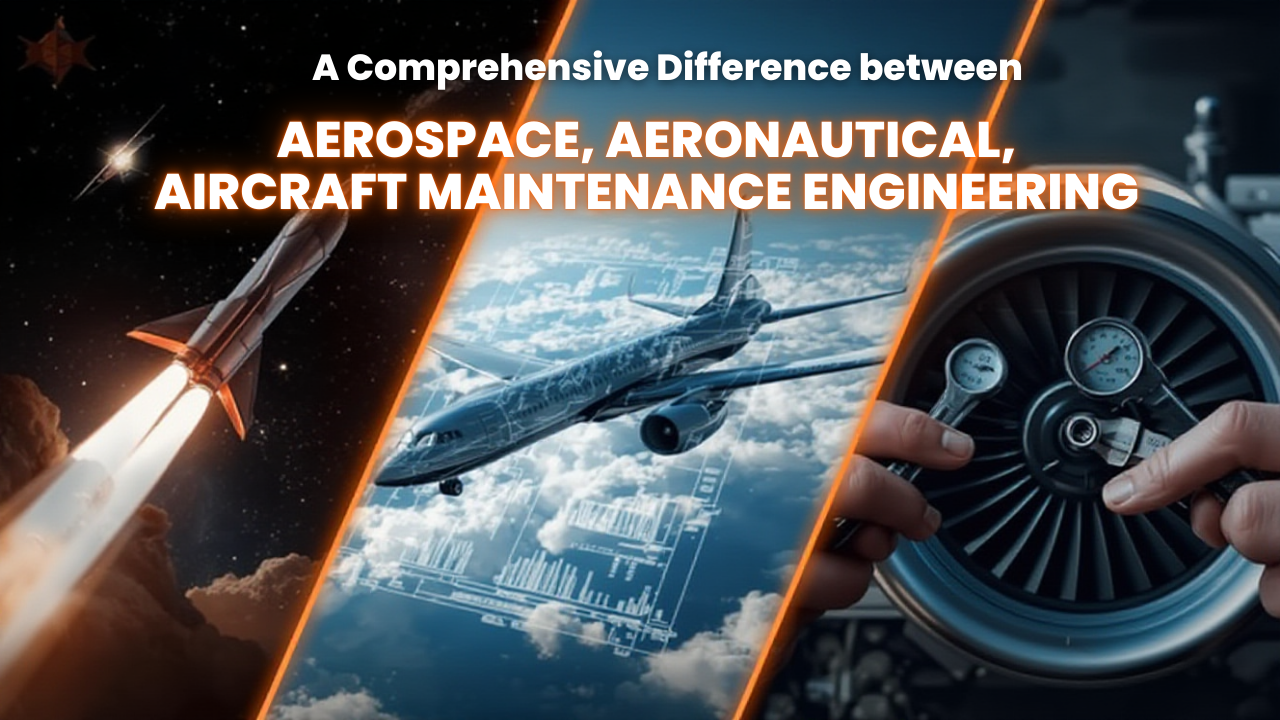
A Comprehensive Difference between Aerospace, Aeronautical & Aircraft Maintenance Engineering
- AME
- June 16, 2025
Ever wondered what exactly separates Aerospace engineering from Aeronautical engineering, and how Aircraft Maintenance Engineering (AME) fits into the picture? It’s like comparing a chef, a pastry chef, and a kitchen mechanic—each works with food, but their roles, skills, and tools differ. In the aviation world, understanding these distinctions is crucial for students planning their careers, employers scouting for talent, and enthusiasts who simply love to dive into how things fly and stay flying. Buckle up, because we’re about to navigate through these three fascinating branches of aviation and explore their unique scopes, applications, and future opportunities.
Understanding the Basics: Aviation Fields Overview
What is Aerospace Engineering?
Aerospace engineering is the broad umbrella covering the design, development, and testing of vehicles that operate in both Earth’s atmosphere and outer space. Think of it as the grand kitchen where anything that flies—be it a commercial jet, a military fighter, or a Mars-bound rocket—is conceptualized. Aerospace engineers dive into aerodynamics, propulsion, materials science, structural analysis, and systems integration. They tackle questions like: How do you make a craft break the sound barrier safely? How can we build lighter yet stronger materials for a spacecraft? Essentially, if it moves through air or space, an aerospace engineer is involved in its creation or improvement.
- Scope: Atmospheric flight (airplanes, helicopters) and spaceflight (rockets, satellites).
- Core Disciplines: Aerodynamics, avionics, propulsion, structural design, and space systems.
- Goal: Innovate new flight technologies, reduce fuel consumption, enhance safety, and push the envelope on exploration.
What is Aeronautical Engineering?
Aeronautical engineering is a focused subset within the broader aerospace field, specializing exclusively in vehicles that operate within Earth’s atmosphere. These engineers study aerodynamic forces, flight mechanics, aircraft design, and materials specifically suited to atmospheric conditions. Picture aeronautical engineers as the pastry chefs in our kitchen analogy—they perfect the craft of making planes fly more efficiently, safely, and with reduced environmental impact.
- Scope: Design and improvement of fixed-wing and rotary-wing aircraft for atmospheric flight.
- Core Disciplines: Aircraft aerodynamics, flight dynamics, propulsion (jet engines/turboprops), and structural mechanics focused on atmospheric stresses.
- Goal: Improve aircraft performance, efficiency, safety, and environmental impact (noise reduction, emissions).
What is Aircraft Maintenance Engineering?
Aircraft Maintenance Engineering (AME) is the hands-on field dedicated to ensuring that every flying machine is safe, reliable, and compliant with aviation regulations. If aerospace engineers are chefs crafting recipes and aeronautical engineers are pastry chefs perfecting specific dishes, AME professionals are the kitchen mechanics and quality controllers. They inspect, troubleshoot, repair, and certify aircraft and their components. Without AME, even the most advanced jets would stay grounded—airworthiness hinges on these experts.
- Scope: Routine checks, troubleshooting mechanical/electrical/fuel/hydraulic systems, structural inspections, repair, and certification.
- Core Disciplines: Aircraft systems (airframe, engine, avionics), maintenance practices, safety procedures, and regulatory compliance (DGCA, FAA, EASA).
- Goal: Maintain peak airworthiness, prevent failures, ensure safety, and extend the lifespan of aircraft.
Education Pathways and Curriculum Differences
Aerospace Engineering Programs
A typical Aerospace Engineering degree spans four years for undergraduates and goes deeper at the master’s and PhD levels. Courses often include:
- Fundamentals: Mathematics (calculus, differential equations), physics, and material science.
- Aerodynamics & Fluid Mechanics: How air flows over surfaces, lift and drag computations.
- Propulsion Systems: Jet engines, rocket propulsion, thermodynamics.
- Structural Analysis: Stress/strain calculations, fatigue analysis, composite materials.
- Control & Avionics: Flight control systems, navigation, and embedded electronics.
Electives can range from spacecraft design to unmanned aerial vehicles (UAVs) and advanced computational fluid dynamics (CFD) simulation. Internships with aerospace giants or research labs are often a crucial part of the program, giving students a taste of real-world challenges.
Aeronautical Engineering Courses
Aeronautical Engineering degrees usually align closely with Aerospace but have fewer modules on space systems and more on atmospheric flight. Typical coursework:
- Basic Sciences: Mathematics, physics, and chemistry.
- Aircraft Aerodynamics: Subsonic and supersonic flight, wind tunnel testing.
- Flight Mechanics & Stability: Performance analysis, stability derivatives, control surfaces.
- Aircraft Structures: Load paths, material selection for wings/fuselage, fatigue testing.
- Propulsion: Emphasis on turbofan, turboprop engines, and commercial aircraft powerplants.
Laboratory sessions might include flight simulators, wind tunnel experiments, and engine test cells. Projects often revolve around designing a concept aircraft for a specific mission, encouraging teamwork and practical problem-solving.
Aircraft Maintenance Engineering Training
AME training is a 2-year program comprising 2,412 hours of instruction, divided across 4 semesters. The focus is on practical, hands-on training aligned with aviation regulatory standards. The curriculum typically includes:
-
Basic Foundation: Mathematics, basic physics, and introductory aeronautics.
-
Maintenance Practices: Inspection techniques, aircraft servicing, safety protocols.
-
Engine Overhaul: Study of piston and turbine engines, component inspection, and repair procedures.
-
Airframe & Systems: Hydraulic, pneumatic, fuel, electrical systems, and structural repair training.
-
Avionics & Instruments: Radio communication, navigation systems, autopilots, and cabin pressurization.
-
Regulations & Documentation: Airworthiness standards (e.g., DGCA in India), logbook entries, and maintenance release protocols.
Practical workshops and hangar sessions dominate the training. Students get to tear down engines, work on landing gear, replace avionics components, and practice nondestructive testing (NDT) methods such as dye penetrant and ultrasonic inspection. By the end, they are ready to sit for licensing exams and step onto the tarmac with wrenches in hand.
Career Prospects and Industry Applications
Careers in Aerospace Engineering
So, you’ve got a degree in Aerospace Engineering—what’s next? Opportunities abound in:
- Aircraft Design & Manufacturing: Working with companies like Boeing, Airbus, or Lockheed Martin to design next-gen jets.
- Space Exploration & Satellite Systems: Organizations such as NASA, SpaceX, or ISRO design rockets, satellites, and space probes—putting humans and machines in space!
- Research & Development: National labs and university research groups work on hypersonic vehicles, advanced propulsion (ion thrusters), or next-gen materials like carbon nanotubes.
- Government & Defense: Military applications, defense contractors developing stealth aircraft or unmanned combat aerial vehicles (UCAVs).
- Consulting & Project Management: Advising airlines, airports, and aerospace firms on new technologies, project timelines, and budget allocations.
Aerospace engineers often find that their critical-thinking and problem-solving skills translate well into other industries too—automotive, renewable energy, even biomedical devices.
Careers in Aeronautical Engineering
Aeronautical engineering graduates typically work in roles focused on the design, development, testing, and production of aircraft and related systems. Common career paths include:
-
Aircraft Design & Development: Working with aerospace manufacturers to design fixed-wing aircraft, helicopters, and unmanned aerial vehicles (UAVs).
-
Aerodynamics & Flight Mechanics: Specializing in airflow analysis, flight performance, and optimization of aircraft structures.
-
Propulsion Systems: Developing and improving jet engines, gas turbines, and propulsion units.
-
Structural Analysis & Materials: Focusing on lightweight materials, composites, and fatigue testing for airframes and wings.
-
R&D and Innovation: Involved in research projects on supersonic travel, green aviation technologies, or space flight systems.
-
Government & Regulatory Bodies: Opportunities in ISRO, DRDO, HAL, or DGCA in roles that involve certification, testing, and aerospace policy.
Aeronautical engineers often collaborate closely with AME teams to ensure designs are maintainable and adhere to regulatory standards, ensuring a smooth transition from concept to operational aircraft.
Careers in Aircraft Maintenance Engineering
For AME professionals, the tarmac is the workplace. Typical roles include:
- Line Maintenance Technician: Daily pre-flight and post-flight inspections, troubleshooting minor issues, refueling, and ramp checks.
- Base Maintenance Engineer: Deep-level maintenance including engine overhauls, structural checks, and major repairs—often conducted in hangars during scheduled maintenance checks (A-checks, B-checks, C-checks, D-checks).
- Avionics Technician: Specialists focusing on electrical and electronic systems, calibrating instruments, and repairing communication/navigation gear.
- Quality Control / Safety Inspector: Ensure maintenance follows regulatory guidelines, conduct audits, and sign off on airworthiness.
- Technical Instructor / Trainer: Teach the next generation of AME students at colleges or training centers.
The AME field is growing as global air travel expands—airlines need skilled hands to keep their fleets flying safely and on schedule.
Skill Sets and Technical Competencies
Core Skills for Aerospace Engineers
- Strong Mathematical Foundation: Calculus, differential equations, linear algebra—think of math as the language of flight.
- Analytical Rigor: Ability to interpret data from wind tunnels, CFD simulations, and flight tests.
- Creativity & Innovation: Developing solutions for weight reduction, fuel efficiency, and novel propulsion methods.
- Software Proficiency: MATLAB, ANSYS, CATIA, SolidWorks—tools that turn ideas into 3D models and simulations.
- Teamwork & Communication: Collaborating with multidisciplinary teams—mechanical, electrical, software engineers, and manufacturing experts.
Core Skills for Aeronautical Engineers
- Aerodynamics Expertise: Deep understanding of lift, drag, stall, and performance parameters.
- Flight Mechanics Knowledge: How changing weight distribution or wing shape affects an aircraft’s stability.
- Structural Analysis Skills: Working with aluminum alloys, composites, and stress analysis to ensure structural integrity.
- Hands-on Testing: Conducting wind tunnel tests, flight demonstrations, and data logging.
- Attention to Detail: Small miscalculations can lead to big flight performance issues.
Core Skills for AME Professionals
- Mechanical Aptitude: Natural ability to troubleshoot mechanical systems—gears, hydraulics, and pneumatic systems.
- Manual Dexterity: Working in tight spaces, handling delicate components, and using specialized tools with precision.
- Regulatory Knowledge: Familiarity with DGCA, FAA, or EASA regulations, certificates, and compliance requirements.
- Problem-Solving Under Pressure: Aircraft are on tight schedules; a quick, accurate diagnosis is vital to avoid flight delays.
- Effective Documentation: Diligent record-keeping—logbooks, maintenance releases, and inspection checklists.
Industry Tools, Technologies, and Innovations
Aerospace R&D and Innovations
Ever heard of hypersonic flight? Aerospace researchers are pushing boundaries—traveling beyond Mach 5 is like hurling you from New York to London in under an hour! Key technologies include:
- Composite Materials: Carbon fiber and titanium alloys that reduce weight and increase strength.
- Additive Manufacturing (3D Printing): Creating complex geometries for engine components, reducing waste.
- Electric & Hybrid Propulsion: Experimenting with electric motors for quieter, more efficient short-haul flights.
- Autonomous Flight Systems: From autopilots to full-fledged UAVs—software algorithms controlling flight paths.
Aeronautical Design and Simulation Tools
Aeronautical engineers rely on a suite of software to bring designs to life:
- CFD Software (e.g., ANSYS Fluent, OpenFOAM): Simulate airflow over wings, fuselage, and control surfaces—like having a virtual wind tunnel in your computer.
- Finite Element Analysis (FEA): Tools like Abaqus help predict stress distribution, preventing catastrophic material failures.
- Flight Simulators: High-fidelity simulators replicate flight conditions for testing new designs and training pilots.
- CAD/CAM Suites (CATIA, SolidWorks): 3D modeling and manufacturing instructions—sketch to prototype in weeks instead of months.
Maintenance and Diagnostic Technologies in AME
For AME professionals, technology is their toolbox:
- Non-Destructive Testing (NDT): Ultrasonic, radiographic, magnetic particle, and dye penetrant testing methods detect cracks without dismantling the structure.
- Digital Maintenance Management Systems (MMS): Software like AMOS or Ramco automates scheduling, parts inventory, and compliance tracking—imagine having a digital checklist that never sleeps.
- Borescopes & Inspection Cameras: Tiny cameras that snake into engines to spot wear and tear—like looking through a doctor’s endoscope, but for jet turbines.
- Predictive Maintenance Analytics: Sensors on critical components feed data to machine learning algorithms that predict failures before they happen—saving time, money, and potentially lives.
Regulatory Standards and Certifications
Aerospace Engineering Certifications
After graduation, aerospace engineers often pursue certifications to deepen their expertise:
- Professional Engineer (PE) License: In many countries, obtaining a PE license demonstrates competence and allows signing off on projects.
- Specialized Certificates: Certifications in areas like Unmanned Aerial Systems (UAS), space systems, or specialized software courses (ANSYS, CATIA).
- Continual Education: Joining organizations like AIAA (American Institute of Aeronautics and Astronautics) or SAE International for workshops and conferences.
Aeronautical Engineering Accreditation
Aeronautical engineering degrees are typically accredited by:
- ABET (USA): Ensures programs meet quality standards, making graduates eligible for licensure and higher studies.
- NAAC / NBA (India): National bodies assess curriculum, faculty credentials, and infrastructure to maintain academic excellence.
- Institutional Recognition: Often, universities partner with industry giants to offer value-added courses, ensuring graduates are industry-ready.
Aircraft Maintenance Engineering Licenses
AME professionals must clear regulatory bodies to practice:
- DGCA License (India): After completing an approved AME course, candidates appear for DGCA exams (Sections A, B1, B2, etc.) to earn licenses for airframe or powerplant.
- FAA Mechanic Certificate (USA): The FAA’s Airframe & Powerplant (A&P) certification allows AME to work worldwide on U.S.-registered aircraft.
- EASA Part-66 License (Europe): Recognized in many countries, Part-66 Category A, B1, B2, or C licenses cover various levels of maintenance tasks and authorizations.
Maintaining these licenses requires continuous learning—renewal often mandates refresher courses and recurrent training to stay abreast of new aircraft models and technologies.
Choosing the Right Career Path: Factors to Consider
Personal Interests and Passion
Ask yourself: Do you get excited about designing cutting-edge spacecraft or improving engine thrust? Or are you more drawn to hands-on troubleshooting, wrench in hand, ensuring each bolt is torque-tight? Identifying what truly excites you is half the battle. If breaking down complex equations to predict flight trajectories thrills you, Aerospace or Aeronautical engineering might be your calling. If you love practical problem-solving and seeing immediate results, AME could be where you thrive.
Job Market and Salary Expectations
- Aerospace & Aeronautical Engineers: Generally command higher starting salaries due to advanced degrees and specialized roles—think design, R&D, and high-stakes projects. Salaries can range from $70,000 to $120,000 annually (USD), depending on location and experience.
- AME Professionals: While starting figures may be more modest (~$40,000 to $60,000 USD), the demand for licensed technicians is skyrocketing, and wages climb significantly with experience, certifications, and specialized skills. Senior AME can easily surpass $100,000 USD in regions with high demand (Middle East, North America, Europe).
Keep in mind, costs of education, licensing fees, and living expenses play a role. However, the aviation industry’s growth suggests stable demand across all three fields, making long-term prospects bright.
Long-term Growth and Opportunities
- Aerospace R&D Careers: Potential to work on moon missions, commercial space tourism, or electric/hybrid aircraft. Cutting-edge research roles often lead to patents, publications, and leadership positions.
- Aeronautical Design & Testing: Opportunities to become chief designers, lead aerodynamicists, or flight test managers. Experienced professionals transition into high-level consulting or executive roles in airlines and OEMs.
- AME Career Ladder: Starting as a technician, you can move to senior engineer, quality control inspector, maintenance planner, and even managerial roles such as MRO Manager or Director of Maintenance. The field also offers chances to transition into teaching, regulatory auditing, or aerospace sales.
Conclusion
Navigating the differences between Aerospace, Aeronautical, and Aircraft Maintenance Engineering is like choosing between writing, editing, and publishing a book—each role is vital, yet distinctly unique. Aerospace engineers dream up futuristic aircraft and spacecraft; aeronautical engineers refine these designs for optimal performance within Earth’s atmosphere; and AME professionals ensure these marvels stay airworthy day in and day out. If you’re eyeing a career in aviation, take stock of your passions, strengths, and the lifestyle you envision. Whichever route you choose, the sky is not the limit—it’s just the beginning.
How AMECollege Supports Aspiring Aviation Professionals
For students seeking expert advice on navigating their path in Aircraft Maintenance Engineering—especially those in India, Nepal, and Bhutan—AMECollege (https://amecollege.in/) offers free, unbiased career counseling. Their mission is to connect you with up-to-date information on approved AME programs, eligibility requirements, and licensing procedures. Through personal “Meet the Team” sessions, AMECollege’s counselors guide you from course selection to exam preparation, ensuring you avoid false promises and reach your aviation goals with confidence.
FAQs
- What is the main difference between Aerospace and Aeronautical Engineering?
Aerospace Engineering covers a broader spectrum including both atmospheric and spaceflight, while Aeronautical Engineering specifically focuses on aircraft that operate within Earth’s atmosphere. - Does an AME license allow me to work on any aircraft worldwide?
An AME license from a reputable authority (DGCA, FAA, EASA) is recognized by many countries, but additional validation or conversion might be required depending on local aviation regulations. - Which field has higher starting salaries: Aerospace or AME?
Generally, Aerospace Engineering roles have higher entry-level salaries due to specialized design and R&D responsibilities. However, experienced AME professionals with advanced certifications can match or exceed these figures. - Can I transition from AME to Aeronautical Engineering or vice versa?
Yes—many AME professionals with strong interest in design pursue Aeronautical or Aerospace degrees. Conversely, engineers who prefer hands-on work may move into maintenance roles after gaining relevant qualifications and licenses. - How can I find the right AME program?
Research accredited institutions, check regulatory body approvals (DGCA, FAA, EASA), and seek impartial guidance—such as free counseling sessions offered by AMECollege—to ensure you choose a program aligned with your goals.
Recent Posts

















































Share This News