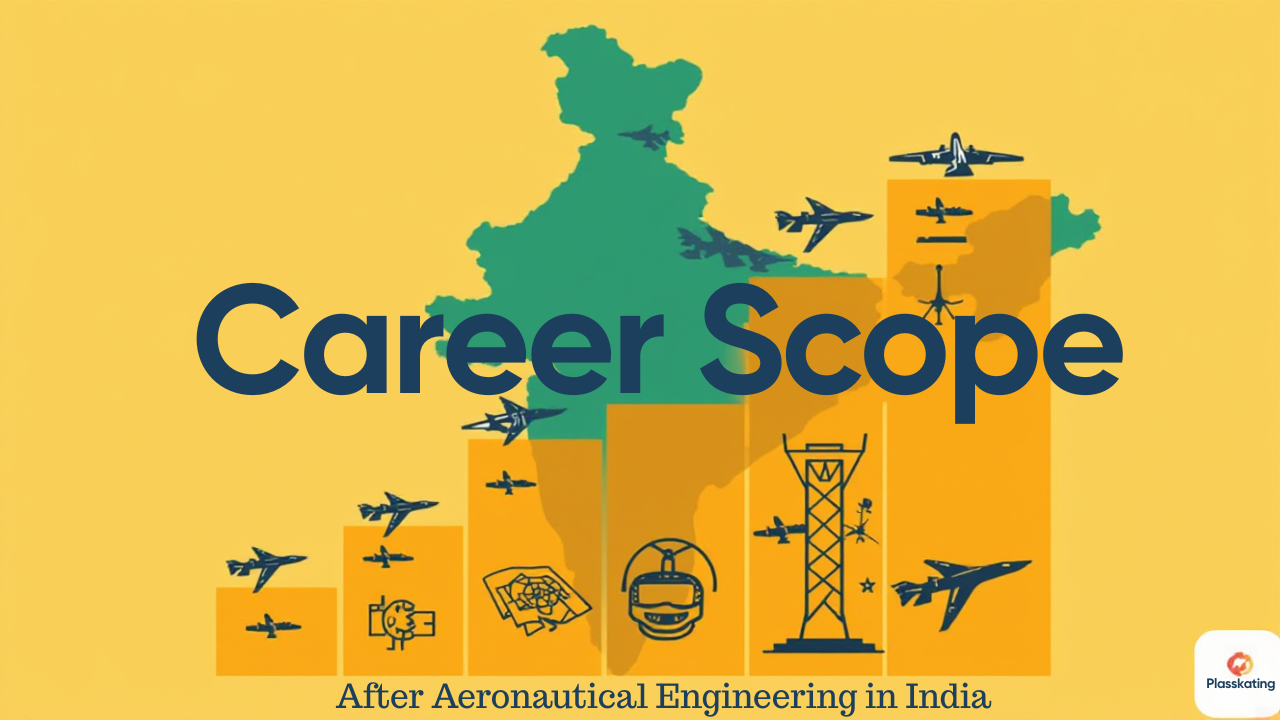
Career Scope After Aeronautical Engineering in India
- AME
- June 27, 2025
Aeronautical engineering is one of the most exciting and dynamic branches of engineering today. If you have a passion for designing, developing, and maintaining aircraft or spacecraft, this field can open up a world of opportunities. In India, the aerospace sector has seen tremendous growth, and aeronautical engineers are in high demand across various industries. In this article, we explore the career scope after aeronautical engineering in India, covering everything from traditional roles to emerging fields, skill requirements, salary trends, and tips for success.
In India, the aerospace and defence sector has grown into a powerhouse worth over ₹6.2 lakh crore (roughly USD 75 billion), and projections show it reaching around USD 70 billion by 2030. Such expansion translates into a wealth of rewarding career paths for aeronautical engineers, ranging from traditional roles in aircraft design and maintenance to frontier areas like space exploration, unmanned aerial systems, and green propulsion technologies.
Let’s dive into each of these areas to see how you can prepare for and thrive in a career after receiving your aeronautical engineering degree in India.
1. India’s Aerospace Industry Landscape
Over the last decade, India’s aerospace and defence (A&D) sector has transformed from a largely maintenance-focused market into an integrated ecosystem encompassing design, manufacturing, research, and services. Key drivers include:
-
Commercial Aviation Growth: Domestic air travel in India has doubled in the past five years, spawning demand for new aircraft, expanded fleets, and maintenance facilities.
-
Defence Modernization: The Indian armed forces are upgrading their air assets, including fighter jets, transport planes, and surveillance aircraft, with significant budget allocations each fiscal year.
-
Space Sector Reforms: Recent policy changes have opened the door for private players in satellite launches, ground station networks, and rocket development.
-
Government Initiatives: Programs like “Make in India” and the National Aerospace and Defence Policy aim to boost domestic manufacturing and high-tech exports.
This holistic growth creates roles across the entire value chain—from concept and design to testing, production, operations, and after sales support.
2. Traditional Roles and Entry-Level Jobs
Aircraft Design Engineer
As an Aircraft Design Engineer, you apply principles of aerodynamics, materials science, and structural analysis to conceptualize and refine the shape and structure of airplanes and helicopters. You use CAD (Computer Aided Design) and CAE (Computer Aided Engineering) software such as CATIA, SolidWorks, and ANSYS to create 3D models, run stress simulations, and optimize components for weight, strength, and manufacturability. Collaboration with propulsion, avionics, and systems engineers ensures a holistic approach to safety and performance.
Maintenance, Repair, and Overhaul (MRO) Engineer
MRO Engineers keep aircraft in peak operating condition. You’ll perform scheduled inspections, diagnose wear and tear, repair or replace faulty components, and certify airworthiness. Roles are available at airlines, independent MRO firms, and military depots. Attention to detail and deep knowledge of regulatory standards from DGCA in India to FAA or EASA internationally are essential.
Flight Test Engineer
Flight Test Engineers validate new designs or upgrades under real world conditions. You plan test protocols, instrument the aircraft with sensors, fly specific maneuvers, and capture data on lift, drag, stability, and control. Back on the ground, you analyze the results to confirm compliance with design specifications and aviation authorities’ regulations.
Quality Assurance and Certification Engineer
Ensuring that every part and process meets stringent quality and safety benchmarks is crucial. Quality Assurance Engineers develop and implement standards, conduct audits, and liaise with certification bodies to ensure compliance at every stage, from raw material procurement to final assembly.
3. Emerging and High-Growth Sectors
Unmanned Aerial Vehicles (UAVs)
Drones have revolutionized applications in agriculture monitoring, infrastructure inspection, parcel delivery, and disaster response. As a UAV Specialist, you’ll work on autonomous flight algorithms, sensor integration, ground control software, and air traffic management interfaces. With India easing regulations on commercial drone operations, this field is experiencing explosive growth and offering lucrative roles in startups and large tech firms alike.
Space Technology and Satellite Engineering
India’s space sector has opened to private enterprise. Aeronautical engineers can now join satellite startups designing Earth observation and communication satellites, develop propulsion modules for small launch vehicles, or manage ground station operations. Careers in mission planning, payload integration, and orbital mechanics are becoming mainstream.
Sustainable Aviation and Green Propulsion
Climate change concerns have spurred research into electric propulsion, hybrid drive systems, and hydrogen fuel cells for aircraft. Engineers skilled in advanced battery systems, fuel cell design, and lightweight composite materials are critical to building the next generation of eco-friendly airplanes. Indian OEMs and research labs are partnering with global institutions to pilot electric and hybrid aircraft prototypes.
Advanced Manufacturing and Additive Techniques
The shift toward 3D printing, robotic assembly, and smart factories is redefining how aircraft parts are produced. Knowledge of additive manufacturing processes, design for manufacturing (DFM), and Industry 4.0 automation positions you to work on innovative production lines that reduce lead times and material waste.
4. Key Technical Skills and Software Proficiency
To stand out, you must master a mix of core engineering concepts and modern software tools:
-
Aerodynamics & Fluid Mechanics
-
Computational Fluid Dynamics (CFD) with ANSYS Fluent, OpenFOAM
-
Wind tunnel test setup and data analysis
-
-
Propulsion Fundamentals
-
Thermodynamics of jet engines and turbofans
-
Emerging concepts in electric motors and fuel cell stacks
-
-
Materials & Structural Analysis
-
Composite laminates, titanium, and aluminum alloys
-
Finite Element Analysis (FEA) with ANSYS Mechanical or Abaqus
-
-
Control and Avionics Systems
-
Flight control laws, stability augmentation, autopilot design
-
Sensor fusion and digital twin modeling in MATLAB/Simulink
-
-
Additive Manufacturing & Automation
-
Design guidelines for 3D printing (DMLS, SLS)
-
Basics of robotic machining and assembly line automation
-
-
Programming and Data Analysis
-
Python for scripting simulations, data processing, and machine learning workflows
-
Familiarity with digital twin platforms and IoT sensor integration
-
5. Essential Soft Skills
While technical prowess opens doors, soft skills foster leadership and collaboration:
-
Communication: Convey complex ideas clearly to multidisciplinary teams and non-technical stakeholders.
-
Teamwork: Partner with electrical, software, and mechanical engineers, as well as procurement and operations personnel.
-
Problem Solving: Innovate under constraints of cost, weight, safety, and time.
-
Adaptability: Embrace rapidly evolving technologies, regulatory changes, and global supply chain challenges.
-
Project Management: Plan and track budgets, timelines, resource allocation, and risk mitigation.
6. Top Academic Institutes and Government Support
India’s premier aeronautical programs include the Indian Institutes of Technology (IITs), National Institutes of Technology (NITs), and specialized colleges offering Bachelor’s and Master’s degrees. These institutes often have state-of-the-art wind tunnels, propulsion labs, and design studios. Strong industry linkages result in internships, capstone projects, and campus recruitment drives by HAL, DRDO, Airbus India, Boeing India, and major MRO players.
Government policies further fuel growth:
-
Make in India: Incentivizes domestic manufacturing of aircraft and components.
-
National Aerospace and Defence Policy: Lays out a roadmap for research, skill development, and private sector participation.
-
FDI Reforms: Increased caps in defence manufacturing attract global OEMs to set up facilities in India.
7. The Value of Internships and Practical Experience
Internships in design bureaus, flight test centers, or MRO facilities are critical to bridging theory and practice. Seek summer placements at HAL, DRDO, SpiceJet Engineering, Air Works, or private UAV startups. Participating in student competitions – SAE Aero Design, Mini Air Vehicle Challenge, or Spaceport Design Contest – not only sharpens your skills but also builds a portfolio that stands out to recruiters.
8. Salary Trends and Compensation Benchmarks
Compensation in aeronautical engineering reflects skill level, specialization, and employer profile:
-
Entry Level (0 to 2 years): ₹3 to 6 LPA for roles in design support, MRO inspections, and test equipment operations.
-
Mid Level (3 to 7 years): ₹8 to 15 LPA for system specialists, project engineers, and test leads in design, propulsion, or avionics.
-
Senior & Management (8+ years): ₹20 LPA+ for program managers, chief engineers, and consultants, especially with global OEMs or major research labs.
Locations like Bengaluru, Mumbai, and Delhi NCR tend to offer the highest packages, reflecting aerospace clusters and higher living costs.
9. International Opportunities and Advanced Degrees
Many Indian graduates enhance their credentials with FAA or EASA certifications to work abroad at Boeing, Lockheed Martin, Rolls-Royce, or Airbus. Alternatively, pursuing a Master’s (M.Tech, MS) or PhD opens doors to research in hypersonics, supersonic transport, and advanced propulsion. Universities in the USA, Europe, and Australia partner with industry and government labs, offering fellowships and projects on the bleeding edge of aerospace research.
10. Entrepreneurship and the Aerospace Startup Ecosystem
India’s aerospace startup landscape is maturing rapidly. Entrepreneurs are:
-
Launching drone-as-a-service platforms for agriculture monitoring or logistics
-
Developing 3D printed engine components and lightweight structures
-
Building software for flight data analysis, predictive maintenance, and digital twins
-
Innovating small sat and launch vehicle architectures
Success in the startup world demands technical acumen plus market research, fundraising, and networking with investors, government agencies, and strategic partners.
11. Challenges and How to Overcome Them
Aeronautical engineering is highly competitive and subject to:
-
Regulatory Hurdles: Certification standards vary by country and technology.
-
Technology Cycles: Rapid advances mean the tools and methods you learn today may evolve.
-
Supply Chain Disruptions: Global events can impact material availability and costs.
To navigate these challenges:
-
Commit to Lifelong Learning: Take online courses in advanced CFD, electric propulsion, AI-driven design, or materials science.
-
Build a Professional Network: Join SAE India, the Aeronautical Society of India, and international forums.
-
Stay Updated: Subscribe to journals like Aerospace America, Journal of Aircraft, and industry newsletters.
12. Tips for Continuous Career Growth
-
Maintain a Diverse Portfolio
Document your projects – design blueprints, test data reports, 3D printed prototypes, drone flight logs. A tangible portfolio speaks volumes in interviews. -
Engage in Mentorship
Seek guidance from seniors, professors, or industry veterans. Offer mentorship to juniors to reinforce your own knowledge. -
Attend Workshops and Conferences
Events like the Aero India Expo, Space Tech Summit, and regional SAE chapter meets offer insights, partnerships, and job leads. -
Acquire Complementary Certifications
Consider PMP for project management, Six Sigma for quality improvement, or specialized courses in UAV regulations and electric aircraft systems. -
Sharpen Soft Skills
Practice presenting complex findings, negotiating budgets, and leading small teams in club projects or hackathons.
Conclusion
The career scope after aeronautical engineering in India has never been broader or more thrilling. Whether your dream is to design the next generation of commercial jets, fine-tune fighter aircraft, launch satellites into orbit, or pioneer eco-friendly electric airplanes, India’s booming aerospace ecosystem and supportive policies offer fertile ground. By combining robust technical skills, polished soft skills, hands-on experience, and a commitment to continuous learning, you can embark on a high-growth, high-impact career that truly takes you beyond the sky. In aeronautical engineering, indeed, the sky is only the beginning.
Recent Posts


















































Share This News