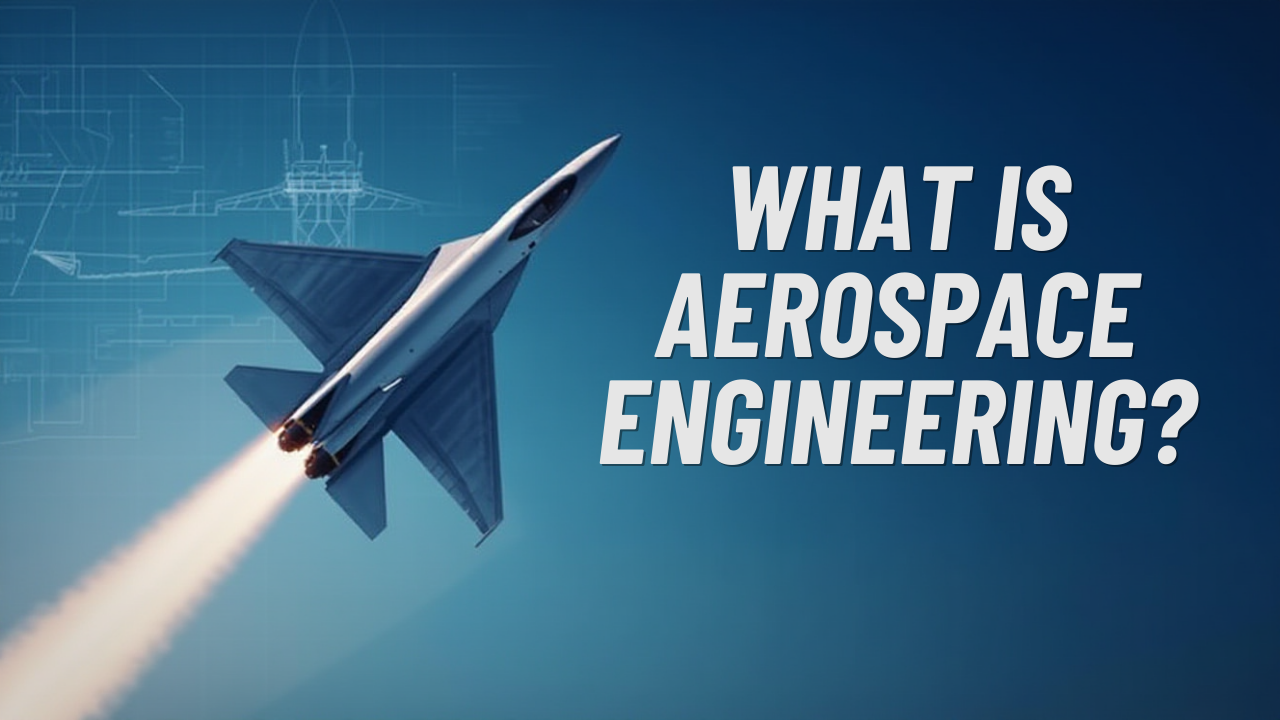
What Is Aerospace Engineering?
- AME
- August 24, 2025
Engineering has many specialized branches that shape modern technology and society. Among them, aerospace engineering stands out as one of the most advanced and fascinating. It combines science, innovation, and design to create machines that fly in the sky and travel into outer space. From commercial airplanes and fighter jets to satellites and rockets, aerospace engineering plays a vital role in connecting the world and exploring beyond Earth.
This article explains what aerospace engineering is, its scope, subjects, industries, required skills, career opportunities, and future potential. If you are interested in working with aircraft, spacecraft, or flight systems, this detailed guide will help you understand the discipline clearly.
Definition of Aerospace Engineering
Aerospace engineering is the branch of engineering that deals with the design, development, testing, and maintenance of aircraft and spacecraft. It focuses on any vehicle that moves through Earth’s atmosphere and beyond.
The field is usually divided into two main areas:
- Aeronautical Engineering – Concerned with aircraft that operate only in Earth’s atmosphere, such as airplanes, helicopters, and drones.
- Astronautical Engineering – Focused on spacecraft and systems that travel outside the atmosphere, such as rockets, satellites, and space stations.
Because it covers both domains, aerospace engineering is a broad discipline that integrates knowledge from mechanical engineering, materials science, physics, thermodynamics, propulsion, electronics, and advanced mathematics.
Importance of Aerospace Engineering
Aerospace engineering is one of the most crucial branches of modern engineering. It contributes to global transportation, defense security, satellite communication, space exploration, and scientific advancement.
- In aviation, it makes air travel safer, faster, and more efficient.
- In defense, it strengthens national security with advanced fighter jets and surveillance drones.
- In space exploration, it enables missions to the Moon, Mars, and beyond.
- In communication and navigation, it provides satellite-based systems that support GPS, weather forecasting, and telecommunication.
Without aerospace engineering, the world would lack efficient global connectivity and the ability to explore the universe.
What Do Aerospace Engineers Do?
Aerospace engineers design and build vehicles that fly. Their work is not limited to airplanes or rockets; it includes every system that contributes to flight performance. Their responsibilities often include:
- Designing aircraft and spacecraft structures.
- Developing propulsion systems, including jet engines and rocket engines.
- Conducting aerodynamic analysis to improve efficiency.
- Testing materials that can withstand extreme conditions in space.
- Running simulations and flight tests for safety and performance.
- Improving navigation, communication, and control systems.
- Researching sustainable fuel and eco-friendly aviation solutions.
In short, aerospace engineers ensure that vehicles can fly safely, efficiently, and reliably, whether inside the atmosphere or beyond it.
Subjects in Aerospace Engineering
Students who study aerospace engineering gain knowledge in several technical subjects. Some of the most important areas include:
- Aerodynamics – The study of how air interacts with flying vehicles.
- Propulsion Systems – Covering jet engines, rockets, and alternative propulsion methods.
- Aircraft and Spacecraft Structures – Analysis of materials and designs that ensure strength and durability.
- Thermodynamics – Understanding energy systems and fuel efficiency.
- Flight Mechanics – Studying forces like lift, drag, thrust, and weight.
- Orbital Mechanics – Essential for spacecraft navigation in space.
- Avionics – Electronic systems for communication, navigation, and control.
- Computational Simulation – Using software to test performance and predict outcomes.
This mix of subjects ensures graduates are well-prepared to work in industries that require both theoretical and practical expertise.
Career Opportunities in Aerospace Engineering
Aerospace engineers have diverse career paths. They can work in research, design, production, testing, or management roles. Some common positions include:
- Aerospace Design Engineer – Focused on creating aircraft and spacecraft models.
- Propulsion Engineer – Specializes in engine development.
- Flight Test Engineer – Conducts tests to ensure safety and performance.
- Satellite Engineer – Works on communication, navigation, and weather satellites.
- Spacecraft Systems Engineer – Develops space exploration vehicles.
- Maintenance and Safety Engineer – Ensures operational efficiency and compliance.
These roles exist in industries such as aviation, defense, research organizations, government agencies, and private space companies.
Industries Hiring Aerospace Engineers
The scope of aerospace engineering is global. Many industries and organizations employ aerospace engineers, including:
- Space Agencies: NASA, ISRO, ESA, JAXA.
- Aircraft Manufacturers: Boeing, Airbus, Embraer, Lockheed Martin.
- Private Space Companies: SpaceX, Blue Origin, Virgin Galactic.
- Defense and Military Organizations.
- Satellite Communication and Navigation Companies.
- Research Institutions and Universities.
These industries require skilled engineers to work on projects ranging from designing passenger jets to developing interplanetary spacecraft.
Skills Required in Aerospace Engineering
To succeed in this field, students need strong technical and analytical skills. Essential abilities include:
- Proficiency in mathematics and physics.
- Knowledge of aerodynamics and thermodynamics.
- Understanding of propulsion systems.
- Competence in computer-aided design (CAD) and simulation tools.
- Strong problem-solving and critical thinking skills.
- Ability to work in teams on large projects.
- Awareness of safety regulations and environmental impact.
Soft skills such as communication, leadership, and creativity also play an important role in professional growth.
Difference Between Aerospace and Aeronautical Engineering
Although often confused, aerospace and aeronautical engineering are not the same.
- Aerospace Engineering covers both aircraft (inside the atmosphere) and spacecraft (outside the atmosphere).
- Aeronautical Engineering is a branch of aerospace engineering focused only on vehicles within Earth’s atmosphere.
In other words, aerospace engineering is the broader field, while aeronautical engineering is a specialized part of it.
Challenges in Aerospace Engineering
Working in aerospace is exciting but also challenging. Engineers face difficulties such as:
- Developing systems that can withstand extreme temperatures and pressures.
- Designing fuel-efficient yet powerful engines.
- Ensuring absolute safety in passenger and defense aircraft.
- Reducing environmental impact with sustainable fuels.
- Managing high research and production costs.
- Keeping pace with rapid technological advancements.
These challenges make aerospace engineering demanding, but they also push innovation and create opportunities for groundbreaking discoveries.
Future of Aerospace Engineering
The future of aerospace engineering is promising and full of innovation. Trends shaping the field include:
- Commercial Space Travel – Companies are developing spacecraft for tourism and exploration.
- Sustainable Aviation – Research into eco-friendly fuels and electric aircraft is growing.
- Autonomous Flight Systems – AI-driven drones and automated aircraft are gaining attention.
- Space Colonization – Future missions aim at building habitats on the Moon and Mars.
- Hypersonic Travel – Development of aircraft that can fly faster than Mach 5.
These advancements will create new career opportunities and transform the way humanity travels and explores.
Salary and Job Outlook
Aerospace engineers are among the better-paid professionals in the engineering sector. Salaries vary by country, industry, and level of expertise.
- In developed countries, aerospace engineers often earn high starting salaries with growth opportunities.
- In emerging economies, the demand for skilled engineers is rising, especially with the growth of space programs and aviation.
Overall, the job outlook for aerospace engineers is strong because of increasing global interest in aviation safety, commercial space travel, and defense technology.
Conclusion
Aerospace engineering is the branch of engineering that takes humans beyond the boundaries of Earth. It combines creativity, technical knowledge, and problem-solving to build aircraft and spacecraft. The field is challenging but rewarding, offering opportunities in aviation, defense, research, and space exploration.
If you are fascinated by airplanes, rockets, and the dream of exploring space, aerospace engineering may be the perfect path for you.
Choosing the right educational institution is just as important as selecting the right career. AME College helps students identify and choose the best colleges for aerospace and aeronautical engineering. With personalized guidance and expert advice, AME College ensures students make informed decisions for a successful future in engineering.
Recent Posts























































Share This News