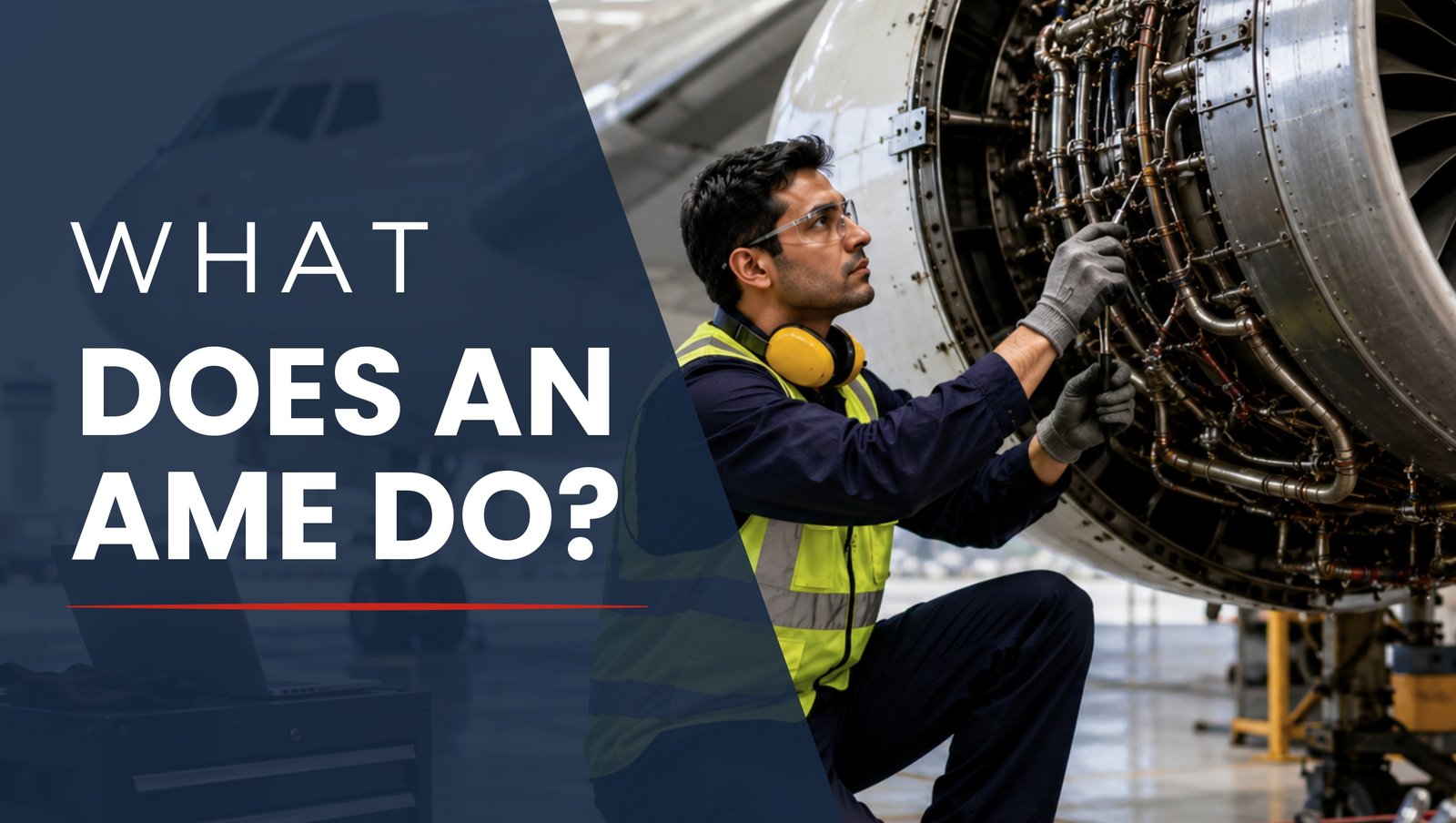
What does an AME do? Roles & Responsibilities Explained
- AME
- June 23, 2026
Introduction
When people think about careers in aviation, the position of an AME is often not given the attention it deserves. AMEs are the ones who inspect, spot problems, fix them, and check every system to make sure everything’s working the way it should. Honestly, nothing takes off without their signature. Legally, a plane cannot take off without a certified AME's sign-off. That signature isn’t just paperwork—it means that everyone on board is safe because of their expertise.
Every day, thousands of aircraft take off and land safely all around the world. All of this is due to the hard work of AMEs who make sure that each aircraft follows the strict standards of aviation before it goes through the certification process for its next flight. To keep passengers, crew members, and aircraft safe, an AME plays an important role in inspecting engines and every part of the aircraft and performing maintenance.
The work of an AME directly affects the safety of the aircraft and passengers. Even the smallest technical issue must be carefully considered before the flight. This type of responsibility requires strong technical knowledge and a commitment to safety.
For students who are interested in aviation and engineering, AME offers a successful career path where technical knowledge is combined with real-world responsibilities. But the question which arises in most of the students' minds is, “ What does an AME do daily?” Here in this blog, you will get complete information about an AME's role and responsibilities.
If you are interested in making a career in Aircraft Maintenance Engineering and want to understand its admission process, eligibility criteria, and top DGCA-Approved AME Colleges in India, Visit Amecollege.in Now.
What Does an AME Actually Do Every Day?
Many students believe that an Aircraft Maintenance Engineer spends the whole day repairing aircraft. But in reality, the job of an AME is much broader than that. An AME is responsible for ensuring that every aircraft is technically safe and fit according to the aviation regulations before it takes to the skies.
The question which comes in most of the students mind, “ What does an AME actually do every day?” So here I want to tell you that the daily responsibilities of an AME totally depends on the type of organisation they are working. Some of them work with airlines, while others have joined maintenance organisations, private aviation companies, defence aviation sectors, and aircraft manufacturing companies. Regardless of the organisation, the goal remains the same—ensuring safe flight.
The typical day of an AME may begin with checking aircraft logbooks, reviewing maintenance reports, and inspecting aircraft that are scheduled to fly. Every day, they may perform different tasks like inspecting aircraft, finding technical problems, supervising repairs, and verifying that all the maintenance processes have been performed correctly.
Curious about how to become an AME? No worries, contact us now.
Why Is An AME Responsible for Aircraft Safety?
Every aircraft carries hundreds of passengers, and even a small technical fault can have serious results if left unattended. This is why aviation authorities have set strict responsibilities on licensed AMEs.
Before an aircraft returns to the field after maintenance, an AME should carefully check that all the tasks have been completed accurately according to the approved standards of aviation. Their signature on maintenance documents serves as confirmation that the aircraft is safe to fly.
This level of responsibility makes this one of the most safety-critical professions in the aviation industry. Pilots fly the aircraft, but the confidence for safe flight begins with the work performed by a licensed AME on the ground.
Want to learn how students are trained to handle such critical responsibilities? Visit AMECollege.in to explore approved AME programs and get complete career guidance from the experienced mentors.
Major Roles and Responsibilities of an AME
Conducting Aircraft Inspections
Aircraft inspection is one of the major parts of an AME’s job. These inspections are performed before & after the flights, and also at scheduled intervals determined by the aviation authorities.
An AME examines various aircraft systems, including landing gear, hydraulic systems, electrical systems, and engines. The purpose is to identify any damage or fault before they become safety concerns.
Troubleshooting Technical Defects
Modern aircraft contain thousands of interconnected components. So when a malfunction occurs, only a licensed AME can investigate the issue using the maintenance records, technical manuals, testing equipment, and diagnostic procedures.
Finding the exact fault often requires technical expertise, patience, and a deep understanding of aircraft systems.
Supervising Maintenance Activities
Aircraft maintenance involves different procedures like routine servicing to major repairs. An AME makes sure that maintenance work is done according to the approved aviation standards.
While adjusting aircraft engine systems, replacing faulty parts, or conducting operational tests, every task must meet the strict safety requirements.
Verifying Aircraft Airworthiness
One of the most important responsibilities of an AME is to check whether the aircraft is safe to fly or not.
Once the inspection and maintenance is complete, the licensed AME performs the final check to make sure that all the systems of the aircraft are functioning properly. Only after that is the aircraft approved for flight.
This responsibility directly relates to the safety of the passengers.
Maintaining Aircraft Documents
Aviation is a highly disciplined industry where every maintenance action must be documented.
An AME always records the repairs, inspections, maintenance procedures, and component replacements in official maintenance records. Only accurate documentation provides a complete maintenance record of the aircraft.
Following Aviation Regulations
Aircraft maintenance is governed by strict national as well as international aviation standards. An AME should stay updated with manufacturer recommendations, changing regulations, and safety procedures.
With these aviation regulations, an AME must ensure safe flight.
Understanding the responsibilities of an AME is the first step towards building a successful aviation career. AMECollege.in helps students to find the top AME colleges and make the right decisions.
Skills Every Successful AME Must Possess
Becoming a successful AME requires much more than technical knowledge. As this profession demands strong technical skills, a good understanding of all the parts of the aircraft, strong problem-solving skills, discipline, and a safety-first priority mindset.
An aircraft maintenance engineer must be capable of identifying faults that may not be immediately visible and making decisions that directly affect the safety of the aircraft. In this profession, good communication skills are also very important because AMEs have to coordinate with engineers, pilots, technicians, and maintenance teams.
Work Environment of an AME
Unlike many other engineering professions, which are office-based, the AMEs' work environment is highly dynamic. Aircraft Maintenance Engineers may work inside airport terminals, aircraft hangars, on the airport ramp, and in the maintenance facilities.
Often, they have to work around sophisticated aircraft systems, cutting-edge advanced technologies, and advanced tools. An AME also works in shifts depending on the airline's maintenance requirements and schedules.
Types of Aircraft Maintenance Performed by an AME
An Aircraft Maintenance Engineer (AME) is involved in different categories of aircraft maintenance. The performance of an AME depends on the condition and operational requirements of the aircraft.
Line Maintenance
Under this type, the routine checkup comes, which is performed before and after the flight. This is to ensure that the aircraft is ready for the operation.
Base Maintenance
Under this, the licensed aircraft maintenance engineers did the detailed inspection in maintenance hangars where the aircraft may remain grounded for several days.
Preventive Maintenance
After the detailed inspection, they scheduled the servicing for the technical issues before they occur.
Corrective Maintenance
Then they repair and replace the defective components after the faults have been identified.
By performing these maintenance activities, an AME increases the aircraft safety, operational efficiency, and reliability.
Challenges Faced by an Aircraft Maintenance Engineer
While AME is a respectable profession, it also comes with different challenges and responsibilities.
Aircraft Maintenance Engineers worked under strict timelines, especially when the aircraft is scheduled to fly at particular intervals. So they must identify and solve the technical faults while following the aviation regulations.
This profession requires continuous learning because aircraft technology is developing very fast. In order to keep updated, an AME must update their knowledge about the aircraft systems, safety standards, and maintenance procedures.
Along with these challenges, the direct contribution to aviation safety makes this profession highly respected in the aviation industry.
Why AME Is One Of The Most Important Careers in Aviation
The aviation industry means safety, technical excellence, and reliability. AME contributes to three of them. They make sure that passengers travel safely, and that the aircraft is working properly.
This unique responsibility makes Aircraft Maintenance Engineering one of the most respected professions in the aviation sector.
This is the best career option for those students who are passionate about engineering, technology, and aviation. Aircraft Maintenance Engineering is the only program which combines technical expertise with real-world responsibilities and hence offers excellent growth opportunities.
Future Scope of Aircraft Maintenance Engineering
Due to the expansion of the airlines' fleets and the increasing air travel worldwide, the demand for skilled AME is also increasing.
Modern aircraft are more technologically advanced, thus creating opportunities for AMEs with specialised technical skills. In addition to airlines, these professionals are working in different sectors of defence aviation, business aviation, international aviation sectors, aircraft manufacturing companies, and Maintenance, Repair, and Overhaul (MRO) organisations.
Looking to build a future in the growing aviation industry? Explore leading AME colleges now.
Conclusion
An AME plays an important role in the aviation industry by ensuring that the aircraft is airworthy, safe, and reliable. From conducting inspections and diagnosing technical problems to certifying the aircraft for flight, these responsibilities directly impact the passengers' safety and flight performance.
As the aviation industry is growing, the demand for qualified Aircraft Maintenance Engineers is expected to increase in both India and abroad. For students who are passionate about the engineering and aviation industry, AME offers excellent growth opportunities for them.
Still confused about whether to choose AME or not, Contact AMECollege.in now, where our experienced aviation mentors are always ready to help students to plan their career journey. Here you will find the list of top Dgca-Approved AME colleges along with their complete course details, eligibility criteria, admission process, and even career opportunities after the AME course. We also offer the IASAT scholarship exam for students who want to join but cannot complete their dream due to their family income.
Visit AMECollege.in today and make the first step towards a bright future in the aviation industry.
Frequently Asked Questions
Q1. What is the full form of AME?
The full form of AME is Aircraft Maintenance Engineering.
Q2. What does an AME do?
An Aircraft Maintenance Engineer (AME) is the one who does maintenance, inspection, troubleshooting, repairing, and certification of aircraft to ensure that they are safe to fly. A licensed AME plays an important role in aviation safety, as an aircraft can only fly after their legal approval.
Q3. What are the main responsibilities of an AME?
The main responsibility of an AME includes aircraft inspection, finding technical faults, supervising maintenance activities, maintaining technical records, ensuring everything follows the aviation regulations, and certifying the aircraft for flight after maintenance is completed.
Q4. Is an AME responsible for passenger safety?
Yes, an AME is directly responsible for the safety of the passenger. By identifying and resolving the maintenance issues before the flight, the Aircraft Maintenance Engineer helps pilots, crew members, and the aircraft ensure a safe flight.
Q5. Where do Aircraft Engineers work?
Aircraft Maintenance Engineers can work in different fields of aviation like MRO organizations, airlines, defence aviation sectors, business aviation sectors, and many more.
Q6. Can an aircraft fly without the approval of an AME?
No. After the complete inspection and maintenance, a licensed AME will certify the aircraft for flying. Without the legal certification of an AME, the aircraft can not fly.
Q7. Is an Aircraft Maintenance Engineer a good career?
Yes. An aircraft maintenance engineer is considered one of the fastest-growing career choices in the aviation industry.
Q8. What is the future scope of an AME in India?
The future scope of an AME in India is very promising. With the increasing number of aircraft fleets and airlines, the demand for skilled aircraft maintenance engineers in India is increasing very fast.
Q9. How can I become an Aircraft Maintenance Engineer?
To become an aircraft maintenance engineer, students must meet the eligibility criteria and then choose the right AME college. AMECollege.in is one of the best education portals in India where you can get complete career guidance, and can explore different DGCA-Approved colleges, and many more.
Q10. Where can I find the information about AME admission and colleges in India?
To get the complete information about the AME admission and top colleges in India, visit the official website of the amecollege.
Recent Posts


















































Share This News