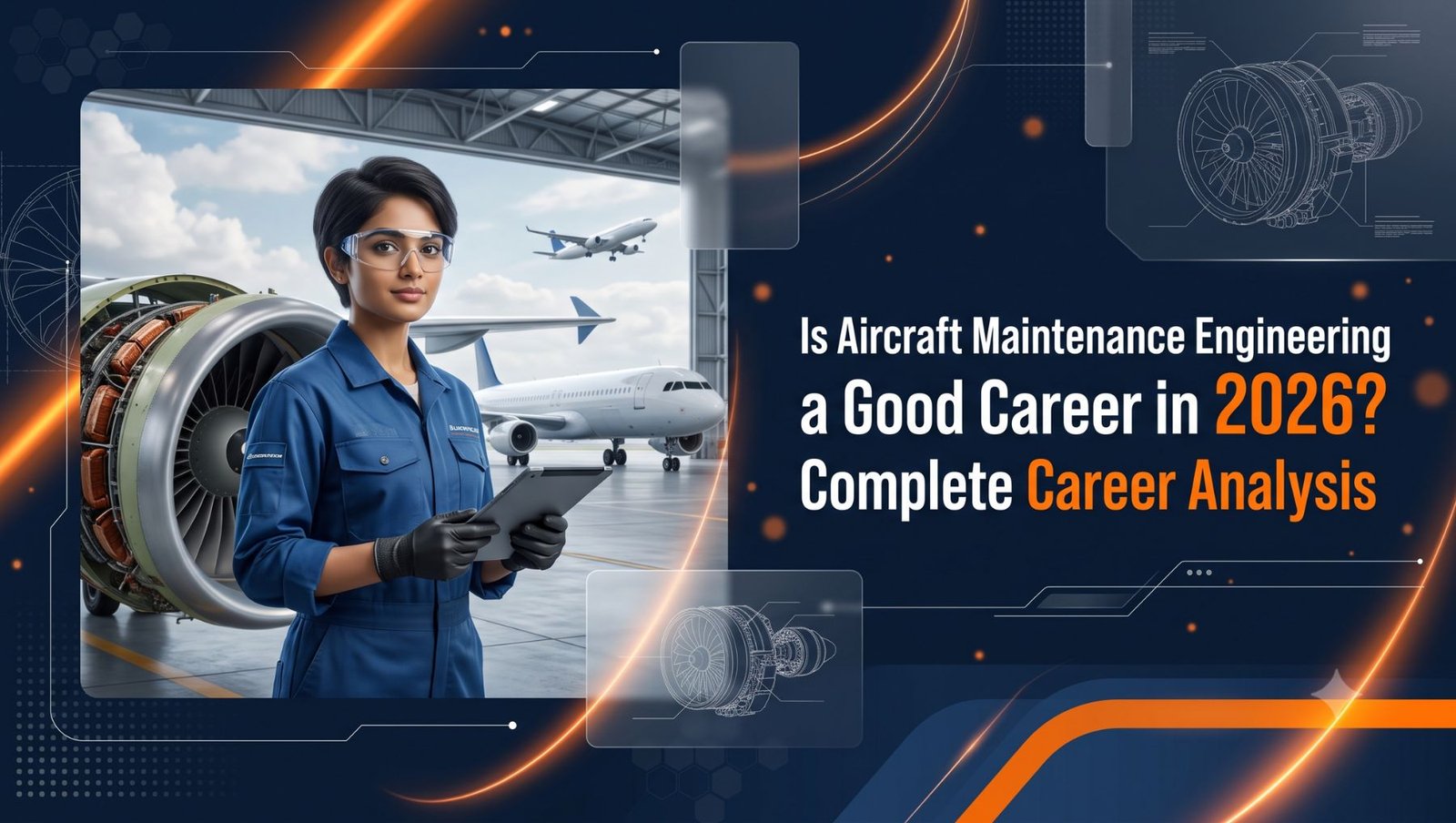
Is Aircraft Maintenance Engineering is a Good Career in 2026? Complete Career Analysis
- AME
- August 20, 2026
Introduction
Yes, Aircraft Maintenance Engineering (AME) is a good career option for students interested in aviation, engineering, and technical work. As India’s aviation industry continues to grow with new airline routes, larger aircraft fleets, and growing Maintenance, Repair, and Overhaul (MRO) facilities, the demand for skilled Aircraft Maintenance Engineers continues to grow.
So, if you’ve just finished your Class 12th and can’t stop thinking about airplanes, maybe you’ve found yourself wondering:
“Is Aircraft Maintenance Engineering actually a good career for 2026?”
Honestly, the answer depends on several factors—what is your interest, where you want your career to go, whether you’ve got the knowledge for technical stuff, and how well you get the industry. The jobs are definitely out there, and the field needs good people, but it’s also a path that expects you to be responsible, precise, and always learning something new.
This guide covers everything you need to know about a career in Aircraft Maintenance Engineering (AME)—what the job actually involves, expected industry demand in 2026, what roles you can land after you finish the course, pay ranges based on experience, what’s great (and not so great) about the field, future growth (in India and abroad), the core skills you’ll need, and, honestly, whether this is the right path for you.
-
What Aircraft Maintenance Engineering is Current industry demand in 2026
-
Career opportunities after completing the course
-
Salary expectations at different experience levels
-
Advantages and challenges of choosing AME
-
Future growth prospects in India and abroad
-
Skills required to succeed
-
Whether AME is the right career choice for you
By the end of this article, you'll have a clear understanding of whether Aircraft Maintenance Engineering is the right career path for your future.
Why this guide is different
Most articles simply claim that AME is a “high-demand career” and leave it at that without explaining. Here, we’re digging into the real stuff—industry trends, how your career can grow, what you’ll earn, licensing steps, and what daily work actually looks like. If you’re comparing AME against other technical careers, or figuring out your next move after Class 12, this guide is designed to help you make a smart, well-grounded decision about your future.
Quick Look: Aircraft Maintenance Engineering in 2026
Thinking about a career in Aircraft Maintenance Engineering (AME)? Here’s what you need to know upfront.
|
Category |
Details |
|
Course Name |
Aircraft Maintenance Engineering (AME) |
|
Career Field |
Aviation |
|
Who’s It For |
Students who have completed 10+2 with Physics, Chemistry, and Mathematics (PCM), or an equivalent qualification, subject to meeting other eligibility criteria. |
|
What You Will Do |
Keep the aircraft safe and airworthy through inspection, maintenance, repair, troubleshooting, and certification. |
|
Where You Will Work |
Commercial airlines, MROs (Maintenance, Repair, and Overhaul organizations), airports, aircraft hangars, workshops, business aviation companies, and other aviation organizations. |
|
What Will Your Syllabus Be |
Aircraft systems, aircraft engines, avionics, maintenance practices, aviation safety, airworthiness requirements, and aviation regulations. |
|
Skills Required |
Analytical thinking, attention to detail, problem-solving abilities, teamwork, communication skills, and a safety-first attitude. |
|
Career Choices Available |
Commercial airlines, MROs, cargo airlines, helicopter operators, business aviation, aircraft manufacturers, aviation training institutions, and government aviation authorities. |
|
Starting Salary |
Approximately ₹3–₹6 LPA, depending on the organization, job role, location, and experience. |
|
Career Progression |
Growth depends on technical skills, work experience, DGCA license, additional certifications, and continuous career development. |
|
International Career Prospects |
Excellent opportunities worldwide, provided you obtain the required aviation licenses and meet the regulations of the destination country. |
|
Future Career Prospects |
Strong, driven by the rapid growth of the aviation industry, expanding aircraft fleets, technological advancements, and increasing demand for qualified Aircraft Maintenance Engineers. |
*Salary figures are approximate—what you earn depends on a bunch of factors like where you work, your experience, and the specific role.
Statistics on Aircraft Maintenance Engineering Industry (2026)
-
India has become the third-biggest aviation market in the world.
-
Boeing projects hundreds of thousands of additional aviation maintenance technicians to be needed in the world in the coming 20 years.
-
The MRO industry in India is growing because of government interventions.
-
There are orders for new aircraft by the airlines from Airbus and Boeing.
-
Airports are being developed in India.
Why Students Consider AME as a Career
Aircraft Maintenance Engineering isn’t just another technical course. It’s a profession that combines the principles of engineering with practical application in an environment where safety is the priority. For every flight that takes off, it’s due to the hard work of qualified mechanics who make sure that the aircraft is safe to fly.
For those students who are passionate about aviation, interested in problem-solving, and willing to get their hands dirty, becoming an AME offers an opportunity to develop valuable experience in the field while directly contributing to aviation safety.
Aircraft Maintenance Engineering: The Basics
If you are trying to figure out whether Aircraft Maintenance Engineering would be the right career path for you or not, then it is important that you first understand the job description of the role.
These professionals inspect, repair, test and certify all kinds of aircrafts – from passenger planes and cargo planes to business jets and helicopters – to prepare them for flight. Every airplane needs to undergo a series of inspections prior to being declared flight-worthy, and it is up to the Aircraft Maintenance Engineers to do so.
In simple words, pilots operate the aircraft, aerospace engineers create the aircraft, and Aircraft Maintenance Engineers maintain the aircraft. They work with aircraft systems, spot technical problems, take care of repairs, and double-check that all the work matches aviation regulations.
There’s really no room for mistakes here. The job demands sharp attention to detail, solid technical skills, and a real commitment to safety. Even a small defect can cause big trouble, which is why AMEs follow strict aviation rules for every inspection and maintenance job.
What Does an Aircraft Maintenance Engineer Do?
Every day Aircraft Maintenance Engineers (AMEs) have many jobs to do. They examine aircraft before and after the flight to see if anything is not right. If something’s off with the mechanics, hydraulics, electronics, or avionics, they figure out what’s wrong and fix it. Sometimes that means swapping out a faulty part, sometimes it’s a full repair job.
These are some of the daily tasks performed by the Aircraft Maintenance Engineer:
-
Aircraft inspections before and after take-off and landing.
-
Identify any problems associated with the mechanical, electrical, hydraulic, and electronic systems of the aircraft.
-
Replacement or repair of damaged aircraft components.
-
Maintenance of aircraft according to the manufacturers' instructions.
-
Maintaining all records of inspections and repairs done.
-
Ensuring that all maintenance services are conducted according to the safety legislation applicable in the aviation industry.
-
Cooperating with technicians, pilots, and airline maintenance personnel in order to keep the aircraft functioning properly.
-
Furthermore, they work according to a very tight schedule provided by the manufacturer.
Regulations in aviation are no joke—everything has to be up to standard.
AMEs don’t work in isolation, either. Constant interaction with the technicians, pilots, and flight crews is a regular part of their lives. And based on their specialization, you will find them working with everything ranging from commercial airliners to helicopters, cargo planes, business jets, or military aircrafts.
Is Aircraft Maintenance Engineering a Good Career in 2026?
Yes, Aircraft Maintenance Engineering has great potential in 2026, but you have to be realistic and committed from day one.
If you think of entering this field, you have to realize that being an engineer in this field means more than a degree. You need hands-on skills, solid training, the right licenses, and a constant drive to keep learning. That’s just the reality.
What’s different about aircraft maintenance compared to a lot of other technical jobs?
The need doesn’t swing up and down wildly. Airlines—no matter if they’re flying across the country or overseas—always need someone to check, service, and maintain their planes. There’s simply no way around it. So, Aircraft Maintenance Engineers are central to keeping the whole industry running.
Why is AME Becoming More Relevant in 2026?
Some of the factors that have raised the demand for skilled maintenance technicians in the field of aviation include:
Increase in Number of Air Passengers
There is an increase in the number of air passengers, not only in India but also all over the world. More routes mean more planes—and every single plane needs regular checks and care from trained engineers.
Expansion of Airline Fleets
It’s not just the big, well-known airlines—startups and new carriers are buying planes, too. Whether it’s a jet on a short city-to-city hop or a long-haul flight crossing continents, they all rely on certified maintenance people to keep passengers and crews safe.
Rise of MRO Facilities
New MRO facilities are opening, and the government wants more of this work done locally. This is great for engineers, because jobs aren’t just locked inside major airlines—you can also work for independent MROs, business aviation companies, and support services.
Technological Advancements
The technology in modern aircraft is another game-changer. In today’s world, aircraft have state-of-the-art avionics, digital monitors, cutting-edge materials, and diagnostic systems on board.
AMEs aren’t just greasing wheels; they’re handling cutting-edge technology. Staying sharp and learning new systems along the way keeps your skills valuable and your career moving forward.
Things Every Student Should Consider
People thinking about this career path should be ready for:
-
Continuous learning of technologies as aircrafts change with time.
-
Being trained both practically and theoretically.
-
Operating in strict and safety-conscious environments.
-
Being able to analyze things and solve problems.
-
Gaining experience progressively to move forward professionally.
Who Should Choose Aircraft Maintenance Engineering as Profession?
When choosing your profession, it is not always about what is popular now or how much it pays. When it comes to Aircraft Maintenance Engineering, it is a bit different from regular professions; you need technical knowledge, discipline and a sense of responsibility.
You Have an Interest in Aviation
Are you fascinated by the engineering behind flying machines like airplanes which fly people hundreds of kilometers, land, and start another flight?
Having that real passion for aviation doesn’t just make classes easier; it keeps you excited about what you do every day, both in school and once you start working.
Understanding Machinery is one of Your Strengths
An aircraft is a very sophisticated machine composed of thousands of components including engines, landing gears and electronics. If understanding how things work and solving technical problems is what gets your blood pumping, then you should consider pursuing the career of an Aircraft Maintenance Engineer.
You’re Okay with Taking on Responsibility
It goes without saying that Aircraft Maintenance Engineers play an integral role in ensuring the safety of the aviation industry. People in this occupation understand that precision is important and that there are no exceptions to following the guidelines.
You Notice Things That Other People Overlook
Noticing little things that are often overlooked is crucial in the case of Aircraft Maintenance Engineering.Sometimes, it’s just sticking closely to the procedures in the manual. Either way, being sharp and thorough isn’t just useful—it’s one of the best traits an AME can have.
You're Willing to Keep Learning
Aviation is always changing. If you work in this field, you’re always learning—there’s no way around it. The people who keep up, who make an effort to learn what’s new, end up with better jobs and more chances to move up. That’s just how the industry works.
You Enjoy Practical, Hands-On Work
Aircraft Maintenance Engineering isn't your typical desk job. One moment you may be checking airplanes, and the next you will be working with special equipment, fixing something, or even working with your team to get things done. If you enjoy putting your knowledge into practice, then this could be an exciting career for you.
Is AME the Right Choice After Class 12?
If You have 10+2 Physics, Chemistry, & Maths (PCM) and Interested to Choose Aircraft Maintenance Engineering Job after 10+2.
Aircraft Maintenance Engineering is the right career choice for students that:
-
want to build a professional aviation career are inclined to learn how aircraft operate
-
want an aeronautics or aviation related career but don't find the idea of a traditional engineering degree appealing or practical
-
want to learn technical skills that can be immediately applied and used in the field.
-
Are interested in working with cutting edge aircraft systems and advanced technologies
-
want a career within airlines, MRO (Maintenance, Repair, and Overhaul) organizations, business aviation, and other commercial aviation branches
-
want opportunities for career progression and to obtain industry-standard licensing.
Who May Want to Explore Other Career Options?
The world of Aircraft Maintenance Engineering is both gratifying and well compensated, but it isn’t something everyone could really appreciate. You might prefer to think of alternate occupation routes if you:
-
Wish for work that entails really low on-the-job or mechanical effort and action.
-
Aren't entirely thrilled with aircraft or perhaps the machinery world.
-
Don't feel at ease operating according to particular methods and also guidelines.
-
Weren’t willing to go on teaching throughout tehnological advances.
-
Feel that occupation should provide quickly without having a good amount of experience or skills growth.
-
Just picking the job because of what is well-liked as well as the pay can leave you disheartened ultimately, hence get the job you are into!.
Quick Self-Assessment
Before making your decision, see how many of the following statements describe you:
|
Statement |
Yes |
No |
|
I have a strong interest in aviation and aircraft. |
☐ |
☐ |
|
I enjoy solving technical or mechanical problems. |
☐ |
☐ |
|
I pay close attention to details. |
☐ |
☐ |
|
I am comfortable following safety procedures and regulations. |
☐ |
☐ |
|
I enjoy practical learning more than purely theoretical study. |
☐ |
☐ |
|
I am willing to continuously improve my skills throughout my career. |
☐ |
☐ |
If you answered “Yes” to the majority of these sentences, then Aircraft maintenance engineering might be a field that you can explore further. There's no job out there to be successful, but for students who combine interest, quality training and continuous skill development might find it easier to work toward their goals in aviation.
Career Opportunities After Aircraft Maintenance Engineering
One of the most common questions students ask before choosing Aircraft Maintenance Engineering is, "What can I do after completing the AME course?"
The good news is that AME will open a huge door of opportunities within the aviation industry. As the aviation infrastructure is developing continuously and the airlines are expanding their fleets, the need for a skilled AME remains an important part of the industry’s growth.
While career opportunities depend on many factors such as quality training, technical skills, employer requirements, and licensing. AME offers many opportunities for professional development.
1. Commercial Airlines
For Aircraft Maintenance Engineers, commercial airlines are among the largest employers. Their maintenance teams always work to make sure that the aircraft is inspected, serviced, and repaired according to the aviation safety standards.
Depending on experience and qualifications, professionals may be involved in:
-
Line maintenance
-
Base maintenance
-
Scheduled inspections
-
Aircraft troubleshooting
-
Technical documentation
-
Maintenance planning
If you work with an airline then it will provide exposure to modern aircraft, advanced maintenance procedures, and structured career progression.
2. Maintenance, Repair, and Overhaul (MRO) Organizations
MRO organizations are specialized in aircraft maintenance, inspection, component repair, and overhaul services for aircraft and airlines operators.
As the MRO sector of India is growing, thus creating multiple opportunities for skilled professionals who can work on different aircraft types and maintenance projects.
For an engineer the MRO environment helps to gain experience across multiple aircraft systems and maintenance activities.
3. Aircraft Manufacturing Companies
The aviation equipment and aircraft manufacturers companies requires technical professionals during aircraft assembly, quality assurance, testing, production, and post-delivery support.
Individuals who choose to work in this industry will be involved in:
-
Aircraft system inspections
-
Quality control
-
Production support
-
Technical documentation
-
Component testing
-
Customer support services
AME professionals can enjoy working in this career field due to the involvement in the manufacturing of aircraft.
4. Business and Corporate Aviation
Business aviation includes the use of chartered aircraft, private jets, and corporate aircrafts.
These types of aircraft need similar levels of maintenance and safety requirements as regular commercial airlines.
5. Cargo Aviation
The importance of cargo airlines are increased by the growth of global logistics and e-commerce.
Cargo aircraft operate only on demanding schedules and always require regular maintenance, inspections and technical support.
6. Helicopter Maintenance
Aircraft Maintenance Engineers (AMEs) may also build their careers in helicopter maintenance.
Helicopters find extensive applications in:
-
Medical services
-
Offshore industry
-
Military purposes
-
Disaster management
Aircraft maintenance technicians who work in this area gain expertise in systems of rotary wing aircraft and their maintenance practices.
7. Airport Technical Services
Most airports have a need for technical personnel that will take care of aircraft operations on the ground.
The Aircraft Maintenance Engineer can participate in:
-
technical coordination
-
maintenance work
-
aircraft inspections
-
ground equipment management
-
activities related to operation safety.
8. Aviation Training Institutes
The seasoned professionals that like to mentor and educate others can opt for careers in aviation education.
There are many training institutes that need experienced instructors to conduct lessons pertaining to:
-
Systems of aircraft
-
Aviation laws
-
Aircraft maintenance
-
Human factors
-
Safety management
-
Workshops
By sharing information about the industry, one can help the future generation of aviation professionals.
9. Government and Defence Organizations
There are some government organizations and other aviation-related government institutions, along with defense institutions, that recruit technical professionals according to their eligibility, recruitment procedure, and job profile.
Candidates interested in these positions must keep themselves updated with recruitment notices.
10. International Career Opportunities
Aircraft maintenance always follows the internationally recognized safety standards which create opportunities beyond India.
The graduates who gain relevant experience, license or certification, and the meet the aviation regulatory requirements of other countries may become eligible to work with:
-
International airlines
-
Overseas MRO organizations
-
Global aircraft manufacturers
-
Business aviation companies
-
International maintenance service providers
Career Growth Path in Aircraft Maintenance Engineering
In the aviation industry, every successful career begins with learning and practical experience. As professionals gain technical experience and meet licensing or organisational requirements, they may apply for the roles with greater responsibility.
A typical career progression may look like this:
|
Career Stage |
Typical Role |
|
Entry Level |
Trainee / Aircraft Maintenance Technician |
|
Early Career |
Junior Aircraft Maintenance Engineer |
|
Mid-Level |
Aircraft Maintenance Engineer |
|
Experienced Professional |
Licensed Aircraft Maintenance Engineer* |
|
Senior Level |
Senior Engineer / Maintenance Supervisor |
|
Leadership |
Maintenance Manager / Quality Manager / Technical Services Manager |
*Progression to licensed roles requires the appropriate regulatory requirements, exams, practical experience and employer requirements to be met.
A Career with Multiple Possibilities
Aircraft Maintenance Engineering doesn’t mean one single job role, the profession offers different opportunities with commercial airlines, state-of-the-art MRO facilities, corporate aviation, manufacturers, and international aviation bodies, the options for career progressions are extensive. With consistent application in upgrading your expertise and experience you can sustain a successful long term career in one of the worlds’ most safe, technological, and evolving industries.
Aircraft Maintenance Engineering Salary in 2026
While choosing a career, salary is one of the biggest concerns among the students. It’s very normal in humans to compare earning across different professions.
If you choose Aircraft Maintenance Engineering as your career then it is important to understand that their salary will depend on several factors which are practical experience, licensing status, aircraft type, employer, qualification, location, and technical experience.
In AME, the salary and career growth generally improves as professionals gain experience, develop specialized skills, and take on greater responsibilities.
Average Salary After Aircraft Maintenance Engineering
The table below provides an estimated salary range for professionals in the aviation industry. These amounts are indicative and can be variable based on various factors such as the employer, role of employment, location, and individual qualifications.
|
Experience Level |
Estimated Annual Salary |
|
Entry-Level / Fresher |
₹3 – ₹6 LPA |
|
2 – 5 Years of Experience |
₹6 – ₹10 LPA |
|
Licensed and Experienced Professionals |
₹10 – ₹18 LPA or above |
The salaries indicated are indicative and can be variable based on various factors.
What Determines an AME's Salary?
If you are interested in aviation, then you must know that no two Aircraft Maintenance Engineers follow the same career path. Several factors can influence how quickly a professional and their salary grow over time.
1. Experience
In most of the technical professions, experience plays a significant role in the salary growth. As engineers work on different aircraft systems, they solve complex maintenance problems, and gain industry experience, they often become eligible for high level responsibilities and better salary.
2. Licensing and Professional Qualifications
If a professional meets the licensing requirements then they can easily enhance their career opportunities. This will also open the doors to greater responsibilities. The companies always value those who have proper qualifications with strong technical experience.
3. Employer
Salary packages may differ depending on which company an engineer works. Opportunities exist in:
-
Commercial Airlines
-
Maintenance, Repair & Overhaul (MRO) Companies
-
Business Aviation Firms
-
Cargo Carriers
-
Aircraft Manufacturers
-
Aviation Support Companies
Each company has its own salary structure depending on their needs, role requirements, and the experience of the employees.
4. Technical Skills
Those professionals who continuously improve their technical skills and stay updated with modern aircraft technologies often get better opportunities.
In today’s aviation industry, employers only value those engineers first who can work confidently with advanced avionics, composite materials, modern maintenance technologies, and digital diagnostic systems.
5. Location
Location is also one of the important factors for salary. As salary can also vary depending on which city or country an AME is working. Those will get good salary packages who work in metropolitan areas with major airports or aviation hubs.
To get full information about the Salary of an AME, click here.
Is Aircraft Maintenance Engineering a High-Paying Career?
Aircraft Maintenance Engineering is one of those fields of aviation which has the potential to become a financially rewarding career for individuals.
After completing the AME course, the graduates should not expect a high salary immediately. These graduates should view this as a long-term career where the practical experience, knowledge, qualification, and professional development contribute.
Those will get high paying roles who consistently upgrade their skills, gain relevant experience, and get strong technical performance.
Beyond Salary: Other Career Benefits
As salary is important, it is only one part of a successful career. The Aircraft Maintenance Engineering course also has a number of advantages that include:
-
Dynamic working environment driven by technology advances.
-
Access to modern aircraft and advanced maintenance systems.
-
Continuous learning and personal growth.
-
Career options in various aviation spheres of the economy.
-
Possibility to work in the international aviation market provided regulatory and company requirements are met.
-
A profession that allows you to make your technical expertise useful for aviation safety.
Steps to Success
The aviation market offers a great variety of career options to those professionals who manage to combine practical and technical skills.
Those students who can demonstrate good problem solving skills, high-quality practical training and adherence to professional standards will be successful in their career and have good salary opportunities.
In the end, Aircraft Maintenance Engineering is more than a good starting salary because it also means a respected and prospective career.
Advantages and Disadvantages of Pursuing Aircraft Maintenance Engineering
Aircraft Maintenance Engineering like all professions has both advantages and disadvantages. Although being an aircraft maintenance engineer provides many interesting career prospects in the field of aviation, it demands technical expertise, devotion, and dedication to safety.
Before choosing the career, if you will understand both sides of the profession then this will help you to make an informed career decision rather than choosing a course based only on trends or salary expectations.
Advantages of Aircraft Maintenance Engineering
1. Be Part of a High-Responsibility Profession
Aircraft Maintenance Engineers (AMEs) are the ones who play an important role in aviation safety. Before an aircraft is cleared for the flight, it must undergo maintenance and inspection to ensure that it meets the required safety standards.
In fact, this field of expertise can be considered one of the most prestigious and valuable occupations within the aviation sphere due to its direct impact on the level of safety.
2. Expanding Options in Aviation
The constant growth of airports, aircraft companies' development, and expansion of the MRO market result in the increasing number of specialists in Aircraft Maintenance Engineering that are needed by the aviation industry.
There will also be various opportunities in different branches of the aviation industry, such as MRO, business aviation, cargo, aircraft manufacturing, technical services, and commercial airlines.
3. Profession Based on Skills
To be a successful specialist in Aircraft Maintenance Engineering, it is important to possess technical knowledge, professional growth, and practical experience.
When you are becoming more experienced and knowledgeable, you are taking on new responsibilities during your career.
4. Exposure to Advanced Aircraft Technologies
These days, advanced aircraft technology consists of efficient engines, advanced avionics, high-tech materials, and electronic monitoring systems.
Dealing with these advanced technologies helps AMEs enhance their technical abilities, keeping in touch with advanced technologies in the aviation industry.
5. Career Opportunities
One more advantage of AME is that this profession does not limit you to just one working place.
Based on your qualification and experience, you can consider the following job positions:
-
Commercial airlines
-
MRO organizations
-
Business aviation
-
Cargo airlines
-
Helicopter maintenance
-
Aircraft manufacturing organizations
-
Aviation training organizations
-
Technical airport services
-
International aviation organizations
6. Continuous Learning and Career Development
There is always the development of new models of aircraft, technological innovations and methods of maintenance in the field of aviation.
Those people who love to learn and improve themselves professionally, should consider becoming an AME.
Challenges of Aircraft Maintenance Engineering
Just like any other professional field, there are also certain challenges associated with Aircraft Maintenance Engineering that students should be aware of.
Those challenges are:
1. High Attention to Detail
Aircraft maintenance has very little room for error. Engineers need to check every part accurately, work according to prescribed maintenance procedures and record things in their technical logs precisely. A precise approach is quite important on the part of the engineers.
2. Continuous Skill Development
As technology continues to advance in the aviation industry, aviation professionals will need to keep adapting to new developments. The introduction of advanced aircraft systems, improved maintenance practices, and changing standards means that constant education will be crucial for aviation specialists. In general, continuous learning leads to better employment prospects and chances for the aviation professionals.
3. Safety Comes First
Aircraft maintenance engineers operate within an industry that is dedicated to safety. Any maintenance work carried out must adhere to the relevant standards of aviation regulations and procedures. This expectation holds true at all times, meaning that the work will be done according to the established standards regardless of time and circumstances involved.
4. Practical Work Environment
In contrast to purely office careers, Aircraft Maintenance Engineering will usually involve practical work in facilities such as hangars, maintenance facilities, and workshops as well as environments such as airports.
Depending on the kind of job, engineers may be able to spend a great deal of time inspecting aircraft, diagnosing problems, and performing maintenance.
For students who enjoy practical technical activities, this can be one of the most satisfying parts of the job.
5. Responsibility Increases with Experience
With the increasing career progression of professionals, they are likely to take on jobs related to complex maintenance duties and leadership positions.
Hence, the responsibility increases, which also corresponds with the need for proficient technical judgment, effective decisions, and strong cooperation.
A Balanced Perspective
Aircraft Maintenance Engineering does not guarantee instant achievement; moreover, this career is not meant for everyone. It requires a great deal of motivation, self-discipline, technical enthusiasm, and a genuine desire to learn at every point of professional development.
At the same time, those students who have a dramatic inclination toward aviation and love thinking about how to solve issues in the technical field are likely to enjoy working in one of the most innovative safety-oriented industries.
Instead of questioning whether or not AME is an uncomplicated occupation, it is better to ask oneself:
"Am I ready to strengthen the skills and attitude necessary for making progress in this profession?"
If the answer is positive, Aircraft Maintenance Engineering may be a gratifying profession that could offer plenty of prospects in the future.
Aircraft Maintenance Engineering vs Other Career Options
Individuals studying aviation tend to evaluate Aircraft Maintenance Engineering (AME) against the background of other technical programs. While all of them belong to engineering and technology, they lead graduates towards different job opportunities.
It is much better to figure out which course fits one's requirements than to search for the "better" one.
The table given below brings out the distinctions.
Aircraft Maintenance Engineering vs Aeronautical Engineering
Although the names sound similar, the two fields focus on completely different aspects of aviation.
|
Foundation |
Aircraft Maintenance Engineering (AME) |
Aeronautical Engineering |
|
Key Area of Emphasis |
Inspection, maintenance, repair, and airworthiness of aircraft |
Development and design of aircraft and aerospace technology |
|
Type of Occupation |
Operational |
Research and design |
|
Work Setting |
Airline companies, MRO centers, airports, and aircraft maintenance hangars |
Aerospace companies, design firms, and aircraft manufacturing organizations |
|
Main Aim |
Ensure aircraft are safe and airworthy for flight |
Design, develop, and improve aircraft and aerospace technology |
|
Suitable For |
Candidates who are practically oriented and enjoy hands-on technical work |
Candidates interested in engineering design, innovation, and research |
Which one should you choose?
Go for Aircraft Maintenance Engineering when you wish to have direct involvement with flying planes and relish technical aspects of the job.
Go for Aeronautical Engineering when you are fascinated with aircraft design, research, and product development.
Comparison between Aircraft Maintenance Engineering and B.Tech in Mechanical Engineering
|
Criteria |
AME |
Mechanical Engineering |
|
Industry Specialization |
Aviation |
Different industries like manufacturing, automotive, energy, and infrastructure |
|
Field of Specialty |
Aircraft systems and maintenance |
Mechanical systems and applications |
|
Practical Experience |
Maintenance and inspection of aircraft |
Design, manufacturing, and maintenance of mechanical systems |
|
Job Prospects |
Aviation-specific |
Wide range of industrial areas |
|
Best Suited For |
Students who have the specific aim of making their career in aviation can opt for AME. |
Students who want to build a career in different engineering industries. |
AME vs B.Tech in Aerospace Engineering
Both courses are commonly confused since both involve aviation and aircraft. But both have different career paths.
|
Basis |
AME |
Aerospace Engineering |
|
Purpose |
Maintenance of Aircraft |
Designing aircraft and spacecraft, etc. |
|
Nature of work |
Maintenance and Technical Operations |
Simulation, Research and Design, Development, etc. |
|
Industry |
Airlines, MRO, Aviation Maintenance industry |
Aerospace firms, Defense Agencies, Space Agencies, Research organizations, etc. |
AME is usually preferred by students who like to work with operational aircraft, while Aerospace engineering is preferred by those who want to work with designing new Aircraft in future.
Maintenance of Airplanes vs Piloting
Quite a number of aviation enthusiasts cannot make a choice whether to be a Pilot or Aircraft Maintenance Engineer. While these two careers are both involved in making aviation safe, they have totally different tasks.
|
Basis |
Maintenance of Airplanes |
Pilot Training |
|
Main Task |
Inspection, maintenance and certification of airplanes |
Operation of airplanes in flight |
|
Task Focus |
Technical systems and maintenance |
Operations and navigating aircraft |
|
Tasks Involved |
Inspection, maintenance, troubleshooting and repairs |
Flying airplanes, flight planning and communication with air traffic controllers |
|
Skill Required |
Engineering and technical knowledge |
Skills of flying, decision making and situational awareness |
Both career options are highly reputable and what career choice to make will depend on your interest in either engineering or flying.
Which Career is Right for You?
This question is not easy to answer because each student has his or her own skills and interests. If you have interest in being a Maintenance of Airplanes engineer, then you need to have:
Passion for aviation technology.
-
Enjoy working with my hands.
-
Like doing mechanical and electrical problem solving.
-
Desire to work in an area related to aircraft maintenance and safety.
-
Would like to work with aircraft systems rather than design them.
On the contrary, if your interest is in research, product design, manufacturing, software development, or aviation itself, other engineering disciplines or aerospace engineering programs may suit you better.
The Final Decision
Instead of selecting a course purely based on how famous or paying it is, one should consider what kind of tasks he/she wants to carry out daily. Aircraft maintenance engineering is a specialized field for students who are interested in aviation and are willing to face technical challenges while having the responsibility of ensuring the safety standards. In case these characteristics resonate with you, aircraft maintenance engineering can become a rewarding and prosperous profession in aviation.
The selection of an appropriate career should start with understanding one’s skills and interests and choosing the right path that will correspond to them.
Future Scope of Aircraft Maintenance Engineering in 2026 and Beyond
The future of Aircraft Maintenance Engineering looks promising as this industry is growing continuously. The aviation industry is growing in advanced technologies, digital maintenance systems, AI- powered diagnostics, and modern aircrafts.
So the students who are willing to start their career as AME have long-term career growth in India as well as abroad.
Technological Advancements are Creating New Opportunities
In modern times, aircraft technology has advanced significantly compared to ten years ago. The field of aviation is heavily based on various technologies, including:
-
Innovative avionics systems
-
Computerized maintenance records
-
Predictive maintenance technology
-
Composite aircraft structures
-
AI-supported diagnostics
-
Data-dependent maintenance planning
With the increasing use of the above technologies, Aircraft Maintenance Engineers with constant skill development would be prepared to work with advanced aircraft technologies and maintenance methods.
In this aspect, technology serves only as an instrument for engineers rather than replacing them and allows them to conduct inspections more easily, discover faults faster, and enhance the reliability of aircraft.
Global Career Opportunities Continue to Grow
Aircraft maintenance processes adhere to globally accepted safety regulations, which allows skilled professionals to gain access to various opportunities outside their country.
Engineers who possess necessary certificates, licenses, experience, and comply with regulatory requirements of other states can apply for jobs in:
-
International airlines
-
Worldwide MRO organizations
-
Aircraft manufacturers
-
Business aviation companies
-
Aviation support service firms
Is Aircraft Maintenance Engineering Future-Proof?
Every profession has its risk of being affected by the changing technological advances and market conditions. However, it can be said that maintenance of aircraft is a very important aspect of the whole process of using the plane, as planes have to undergo operation checks, maintenance, and certification before flying.
The need for qualified technicians that perform maintenance work while abiding by aviation safety rules will always exist as long as planes keep flying.
Those who have a deep interest in aviation, are ready for constant education, and are willing to develop good technical skills can find an opportunity to work in the field of Aircraft Maintenance Engineering, which will provide them with the possibility of having a successful career.
The process of Aircraft Maintenance Engineering is not only about gaining more demand for this specialization; it is about working in the industry which is guided by technology, safety, and innovation.
How to Start Your Career in Aircraft Maintenance Engineering
After deciding that Aircraft Maintenance Engineering is your ideal career choice, the next step is to understand how to start the process. A solid path to an aviation career entails more than just signing up for a school. One needs to go through the right course and get essential qualifications.
The following method will help you choose a roadmap.
Step 1: Check the Eligibility Criteria
The first step is to ensure that one is eligible for Aircraft Maintenance Engineering training. Generally, the applicants need to have completed 10+2 in the field of Physics, Chemistry and Mathematics (PCM) alternatively they can apply based on the equivalent qualification.
Step 2: Choose the Right AME Institute
Choosing the right university will make a major impact on your professional journey.
When you look at an AME Institute, consider the following factors.
-
Approval and recognition by the relevant aviation authorities.
-
Curriculum focusing on practical training.
-
Good concrete training setting available.
-
Qualified instructors on the staff.
-
Access to aircrafts and laboratories and workshops.
-
Work experience through internships.
-
Job placement help.
-
A good Institute allows preparing students in the best possible way.
Step 3: Focus on Practical Learning
At this stage, try to concentrate on practical training.
Aircraft Maintenance Engineering is a practical field of work.
Classroom lectures bring the basic theoretical knowledge, practical training develops students' understanding of how the aircraft systems operate.
Take time to:
-
Watch how the aircrafts are serviced.
-
Learn to work with instruments and specialized devices.
-
Understand the documents needed for the maintenance.
-
Be active in the workshop sessions.
-
Become acquainted with troubleshooting and inspection processes.
-
The more practical experience you get the more equipped you will be.
Step 4: Develop Technical and Professional Skills
Candidates for employment in this field must have a strong knowledge of the trade and not just a good academic background. Characteristics of the successful Aircraft Maintenance Engineer include: analytical thinking; attention to detail; ability to solve problems; teamwork and communication skills; time management; discipline and professional behavior.
Getting trained in these skills and developing them is important to gaining a better position on the job market.
Step 5: Gain Industry Experience
Industry experience is important in the professional development of individuals.
Through training, internship programs, and technical positions at entry level, students can appreciate how things are done within the airlines.
Each project and maintenance work provides an avenue for honing technical skills.
Step 6: Lifelong Learning to Enhance Your Career
The aviation industry is continuously growing due to advances in aviation, aircraft maintenance and avionics, as well as airworthiness directives,
So it is very important for Aircraft Maintenance Engineers to continuously upgrade themselves by:
1. Enrolling in professional training courses
2. Attending workshops
3. Participating in industry seminars
4. Getting certified.
5. Courses offered by manufacturers.
6. Self-education and various technical publications.
Continuing education allows not only developing expertise but also ensures successful career advancement.
Helpful Advice for Students Aspiring to Pursue a Career in AME
Remember the following useful advice before taking up this career path:
-
Select your institute through careful research and thought.
-
Must have a good working knowledge of math, physics and engineering concepts.
-
Be aware of the recent trends in the aviation industry.
-
Improve your communication skills;
-
Try to get knowledge from experienced professionals in this field.
-
Be patient and keep improving yourself.
Your Journey Begins with the Right Foundation
Aircraft Maintenance Engineering is a career that rewards commitment, discipline, and expertise. All engineers begin as students and acquire their educational and practical skills during training and work.
If you are interested in aviation and willing to study, then you will receive a good start on your way to a successful career in one of the most advanced industries of the world.
The point is not just to graduate but to acquire the necessary skills and professionalism that the industry requires.
Final Verdict: Is Aircraft Maintenance Engineering a Good Career in 2026?
Having examined the fields of industry trends, possibilities of a career, salary potential, future possibilities, and required skills, one can conclude that Aircraft Maintenance Engineering remains a great career choice for aviation lovers who also wish to become great technical specialists.
However, it is important to note that choosing AME is not just about the prospects of getting a high salary or being in demand in the world of aviation.
So, Is Aircraft Maintenance Engineering a Good Choice for 2026?
The answer is affirmative for students who like the elements of practical learning, problem solving, and working with advanced aircraft systems.
-
The specialty of Aircraft Maintenance Engineer offers:
-
A specialized profession in the rapidly growing aviation industry.
-
Career in the sphere of updating techniques of aircraft control systems.
-
Different career paths in various aviation industries.
-
Possibility of continuous career progression.
Why Many Students Choose AME College
Choosing the right institute is a critical first step toward achieving success in any career in the aviation industry. Quality learning connects students with the right resources for studying. At AME College, students receive full academic knowledge together with practical skills and knowledge. All the colleges under AMECollege concentrate on the development of professional competences and skills that are necessary for a successful career in the field of Aircraft Maintenance Engineering.
If you want to start working in the educational sphere, it is crucial to research the course first.
Your Aviation Journey Starts with the Right Decision
Aircraft Maintenance Engineering has become a significant decision for those who want to enter one of the most crucial professions in terms of safety. And if you feel enthusiastic about aviation, if you like studying the functioning of complicated machinery, and if you are willing to advance in your career via continuous self-improvement and technical expertise, this could be your path! It should be noted that your choice of degree does not define your future career, because it all depends on your knowledge and skills, as well as your efforts towards achieving your goals.
Frequently Asked Questions (FAQs)
1. Is Aircraft Maintenance Engineering a good profession in India in 2026?
Certainly, AME is one of the best professions that will have a great scope in 2026 because of the consistent development of the aviation sector in India. There is an expansion in the fleet of airlines, growth in MRO organizations and improvement in airports which provide job prospects for AMEs. Career prospects will largely depend on many things including technical skills, licensing, professional experience and training.
2. Is Aircraft Maintenance Engineering better than Aeronautical Engineering?
None of the courses is universally better as the right choice depends only on your career goals.
Aircraft maintenance engineering focuses on maintaining, inspecting, and troubleshooting the airworthiness of aircraft. Alternatively, Aeronautical engineering entails the design, development, and improvement of systems for aircrafts.
3. What will be the salary post-completion of the Aircraft Maintenance Engineering program?
The salary will depend upon the following factors: experience, employer, technical skill set, license, and employment location.
The salary range may be the following depending on the years of experience:
|
Years of Experience |
Salary* |
|
Freshers |
₹3–₹6 LPA |
|
2–5 Years |
₹6–₹10 LPA |
|
License and Experience |
₹10–₹18 LPA or above |
4. Is it possible to pursue Aircraft Maintenance Engineering after class 12th?
Yes. Those students who have completed their 10+2 PCM or equivalent are eligible for joining an Aircraft Maintenance Engineering program.
5. What Skills are required to Become a Good Aircraft Maintenance Engineer?
The skills required to become a good AME are:
1. Technical skills
2. Attention to details
3. Problem solving skills
4. Analytical skills
5. Mechanics and electronics knowledge
6. Teamwork and communication skills
7. Time management skills
8. Safety awareness
9. Learning skills
These skills assist professionals in performing maintenance activities.
6. What are the career opportunities after Aircraft Maintenance Engineering?
Yes. There are many sectors in which Aircraft Maintenance Engineers can apply, and are:
1. Commercial airlines
2. Maintenance, Repair and Overhaul (MRO) companies
3. Business aviation
4. Cargo aviation
5. Helicopters
6. Aircraft manufacturing companies
7. Airport technical staff
8. Aviation training institutions
7. Can an Aircraft Maintenance Engineer be employed abroad?
Yes. An Aircraft Maintenance Engineer can search for job opportunities in other countries once he meets the requirements needed by that country to hire him.
8. Is Aircraft Maintenance Engineering a difficult field?
Indeed, Aircraft Maintenance Engineering is a tough technical course that needs discipline and practical training. In this course, learners cover topics on various aspects of aircraft, engines, avionics and aircraft maintenance among others.
However, while the course demands constant efforts, students who have a passion for aviation and sciences can find the course interesting and enjoyable.
9. Does Aircraft Maintenance Engineering have a future?
Indeed. With the expansion of aviation, there is no doubt that aircrafts will need to undergo maintenance and servicing to be safe to operate.
With the development in aviation, increasing number of fleets by airlines, and development of MRO facilities, the future of Aircraft Maintenance Engineers looks bright.
Recent Posts






















































Share This News