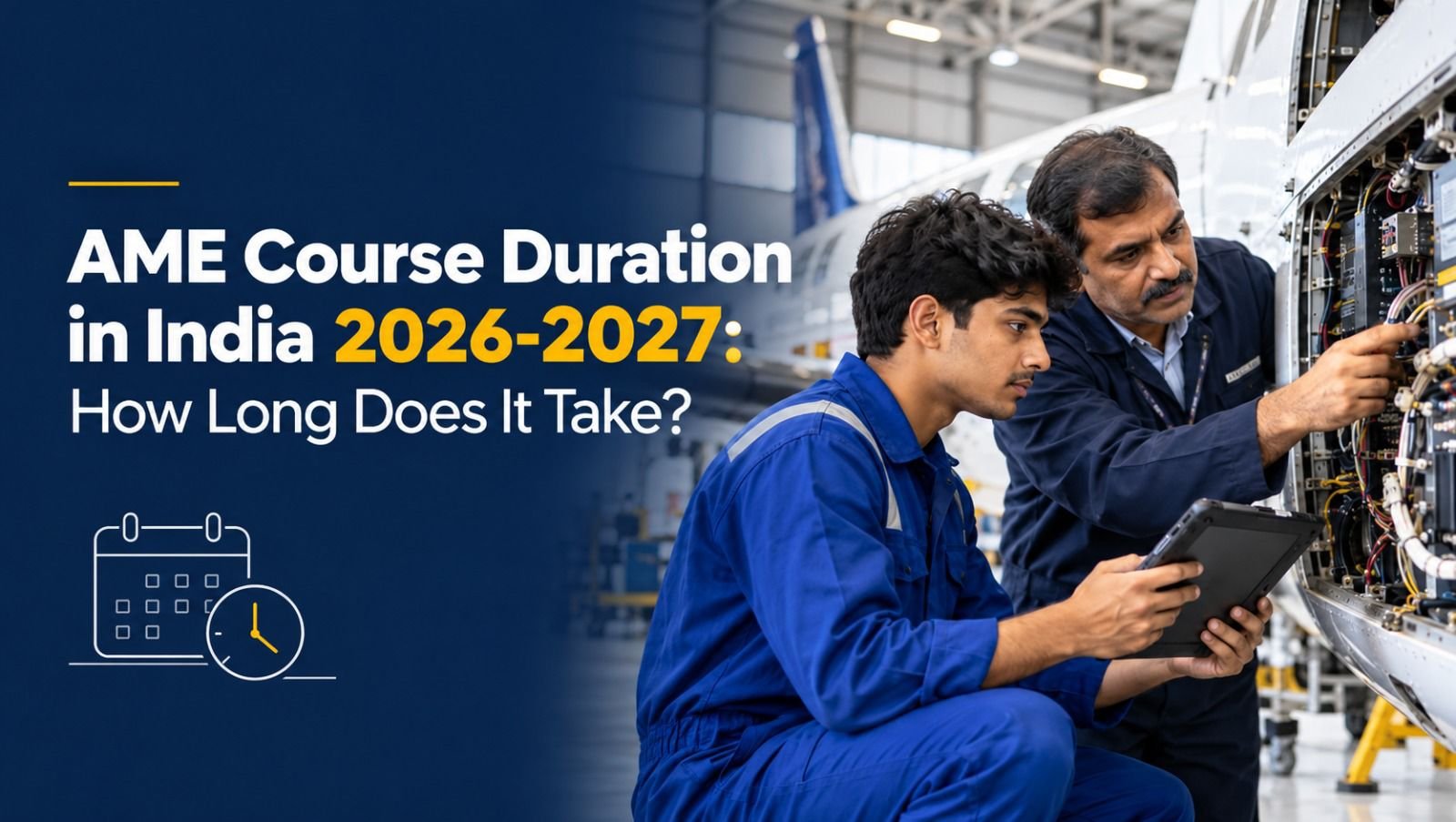
AME Course Duration in India 2026: How Long Does It Take?
- AME
- November 12, 2026
Introduction
Joining Aircraft Maintenance Engineering (AME) after Class 12th can be a tough decision. Along with the knowledge about the course, eligibility and career opportunities, students and parents usually have one important question: How long does it take to complete an AME course in India and become a licensed Aircraft Maintenance Engineer?
An AME training program approved in India can be completed in about 4 years, depending on the institution and the nature of the training program. However, completion of the training program alone does not qualify you for the AME license. It is necessary to fulfill other licensing conditions as well.
The purpose of this guide is to provide you with information regarding the AME course duration in India in 2026, academic training and licensing, B1.1 and B2 streams, and other important things that need to be checked prior to joining any institute.
Quick Answer: How Long Does an AME Course Take in India?
The duration of an Aircraft Maintenance Engineering course depends on the approved programme offered by the institute.
|
Course detail |
Duration or requirement |
|
AME basic training |
Commonly around 4 years, depending on the approved programme |
|
Total Semesters |
Eight semesters |
|
Practical maintenance experience |
Additional time may be required, depending on the applicable licensing route |
|
DGCA examinations |
Must be completed as required for the relevant licence category |
|
Time to obtain an AME licence |
Varies according to training, experience, examinations and other applicable requirements |
Students should therefore check the exact approved course structure rather than assume that every AME college follows the same duration.
1. What is the duration of AME Course After 12th?
Those students who have done their Class 12 with Physics, Chemistry and Maths can consider AME course programs available from recognized institutions.
The AME course conducted at the institution is a 4-year course. In this time frame, the learners receive academic learning and practical training related to the systems of aircraft, maintenance, and aviation safety.
In this course, learners are provided technical knowledge and practical skills needed in the field of aircraft maintenance. They are also provided with knowledge and practical learning related to aircraft engines, avionics, maintenance and other aspects of aircraft engineering.
But after completion of the 4-year course, the learners are not immediately granted the licence of AME. The learners have to satisfy the relevant DGCA requirements as well.
2. Understanding the 4-Year AME Course Structure
In this regard, it is important for students who are interested in pursuing their studies in AME colleges in India to know that the course not only requires theoretical knowledge but also practical training to gain expertise in aircraft maintenance.
In this regard, the four-year course includes:
-
Aircraft Systems: Learning about various parts of aircraft and their operating systems.
-
Aircraft Engines: Learning about the engine parts, operation, and maintenance process.
-
Avionics: Learning about the electrical and navigational equipment on board of an aircraft.
-
Practical Training: Learning about various maintenance procedures of aircraft in workshops.
This combination of theoretical and practical training makes it easy for students to learn about the technical aspects of aircraft maintenance.
It is important that students learn about the licensing requirements and experience criteria before opting for any AME program.
3. What is the time duration of B1.1 and B2 AME Courses?
Both B1.1 and B2 are important types of licence for individuals who are interested in aircraft maintenance.
Though both are related to the safety and maintenance of aircraft, both of them differ in their technical aspects.
Time Duration of B1.1 AME Course:
B1.1 type of licence deals with turbine-powered aeroplanes and it emphasizes mainly on mechanical maintenance.
Training covers areas such as:
-
Aircraft structures and systems
-
Turbine engines
-
Electrical fundamentals
-
Aircraft maintenance practices
-
Materials, hardware and aviation legislation
-
Inspection, troubleshooting and practical maintenance activities
The duration of the basic training programme depends on the approved course structure offered by the institute.
B2 AME course duration
The B2 category focuses on aircraft avionics, including electrical and electronic systems.
Students study subjects such as:
-
Electrical fundamentals
-
Electronic fundamentals
-
Digital techniques
-
Electronic instrument systems
-
Aircraft communication and navigation systems
-
Maintenance practices and aviation legislation
As with B1.1, students must check the duration and training arrangements of the specific approved B2 programme they plan to join.
Which stream should you choose?
B1.1 may suit students more interested in engines, structures and mechanical systems. B2 may be more suitable for students interested in electronics, instruments and aircraft avionics.
Your decision will be based on your interest in technology and career aspirations, and not merely on the duration it will take to complete the program.
4. Does Getting through the AME Course Get You Your Licence?
No. This is the most important information that students should have before attending the course.
Passing an AME training course and obtaining a DGCA Aircraft Maintenance Engineer licence are two different things.
Taking part in an approved basic training course allows one to acquire the required knowledge and skills. However, there are additional requirements that should be met in order to obtain a license. Some of them depend on the category and route chosen to obtain an individual license. These include:
-
Completion of the required initial training.
-
Passing the required knowledge or module tests.
-
Gaining necessary practical experience with aircraft maintenance.
-
Keeping proper records and documentation as required.
-
Fulfillment of the requirements for application and eligibility for a license.
-
This would depend on license class, qualifications, training, and so forth.
Students are encouraged to read about the licensing requirements on the DGCA’s CAR-66 and DGCA Pariksha AME website prior to any assumption on their eligibility for a license.
5. How Long Does It Take to Become a Licensed Aircraft Maintenance Engineer?
The total time required to become eligible for an AME licence can be longer than the advertised course duration.
Consider a student who enrols in a four-year AME training programme after Class 12. Completing the programme does not, by itself, establish that the student has fulfilled every licensing requirement.
Students must also understand the additional practical experience, examinations and other requirements applicable to their chosen licence category and training route
The DGCA's CAR-66 framework specifies experience requirements according to the licence category and the applicant's qualifications and training route. Therefore, students should check the applicable licensing requirements rather than assuming that completing the four-year course automatically makes them eligible for a licence.
Before enrolling, ask the institute for a written explanation of:
-
The duration of the approved basic training programme.
-
The practical training included within that duration.
-
The arrangements for gaining experience on operating aircraft.
-
The applicable examination requirements.
-
The additional steps required before applying for the intended licence.
-
This will give you a clearer image of the whole process of training and certification.
6. What Takes Place within the AME Training Course?
The training course is not only made up of classroom lessons. It includes both theoretical and practical learning of aircraft maintenance and aviation safety.
Although the exact curriculum varies by category and approved programme, students can expect several important areas of learning.
Theoretical training
Students study the scientific and technical principles behind aircraft systems, engines, electrical equipment and maintenance procedures.
They also learn about aviation legislation, human factors, safety practices and technical documentation.
Training in workshop and laboratory
Practical training will help students comprehend the different parts of an aircraft, maintenance equipment, and test devices.
This part of the course connects theoretical concepts with actual maintenance tasks.
Practical maintenance training
Approved programmes include practical training relevant to aircraft maintenance. The extent and setting of this training depend on the approved curriculum and the institute's arrangements.
Students should verify whether the programme includes practical activities in an actual maintenance environment and how those activities are documented.
Examinations and assessments
Students must complete the examinations and assessments specified by their programme and applicable regulatory requirements.
Clear passage in the institute exam does not necessarily mean fulfillment of all DGCA licensing requirements.
7. Can You Complete an AME Course in a Shorter Time?
Some students look for accelerated programmes because they want to enter the aviation industry as quickly as possible.
However, an AME programme must satisfy the applicable approved training requirements. Students should not assume that a shorter advertised duration means they can bypass required instruction, practical training or examinations.
If an institute advertises a particularly short programme, ask for clarification about:
-
Its current approval and approved course duration.
-
The licence category covered by the programme.
-
The total hours of training and practical elements.
-
Any exemptions or credit for previous qualifications.
-
The practical experience required after training.
The program must have its basis on regulatory compliance, training effectiveness, and the way forward as opposed to the time taken to complete the program.
8. What Should You Consider While Choosing AME College?
The length of the course is something you need to think about, but it should not be all that you consider.
Consider the following before choosing:
Approval from DGCA: Ensure that the college has approval for the basic training program that you have chosen.
Duration of training: Determine the duration of training and the number of semesters.
Practical facilities: Check on workshops, labs, aircraft parts and practical maintenance facilities.
Practical maintenance experience: Find out where the practical sessions are conducted, if they include handling aircraft and how they are documented.
Examinations: Find out what exams you have to pass and if their criteria form part of the institution's program.
License requirements: Check what is needed to do before you take the course to qualify for the license.
Costs and time needed: Think about whether the costs include the entire program or whether there be additional costs and time needed in the future.
Frequently Asked Questions (FAQ)
For how many years will the AME course in India be in 2026?
The duration of an AME programme depends on the training structure offered by the institute. The programme is a four-year course that combines theoretical learning with practical training.
Is it possible to study Aircraft Maintenance Engineering after class 12?
Yes, after class 12th students who meet certain eligibility criteria can get enrolled in AME course programmes. Physics, Chemistry and Mathematics are commonly required; students should verify the current criteria for their chosen programme.
Is B1.1 or B2 AME training longer?
The duration depends on the specific approved programme offered by the institute. Students should compare the current course details for each category rather than assume that one stream always takes longer.
Can I get an AME licence immediately after completing the course?
Not necessarily. You must satisfy the applicable knowledge examination, practical experience and other licensing requirements for your category and route.
Does a four-year AME course include all the practical experience required for a licence?
Not automatically. The practical training included in a course and the practical experience required for licensing are distinct matters. Confirm the exact requirements with the institute and DGCA.
Where can I find out the AME licensing requirements?
The requirements can be found in the DGCA website as well as the DGCA Pariksha website.
Conclusion
As for the AME course duration in India in 2026, it depends on the programme approved by the DGCA. The four-year programme covers the academic and practical training period. However, becoming eligible for an AME licence may take additional time, depending on the required practical experience, examinations and applicable DGCA licensing requirements.
In case you want to enter an AME programme after Class 12, compare different colleges and consider their training programs. Pay attention not only to the period of the programme, but also to its content and what you still have to learn before getting a licence.
Understanding the whole process will help you make an appropriate choice regarding your future career in the aviation sphere.
Recent Posts










































Share This News