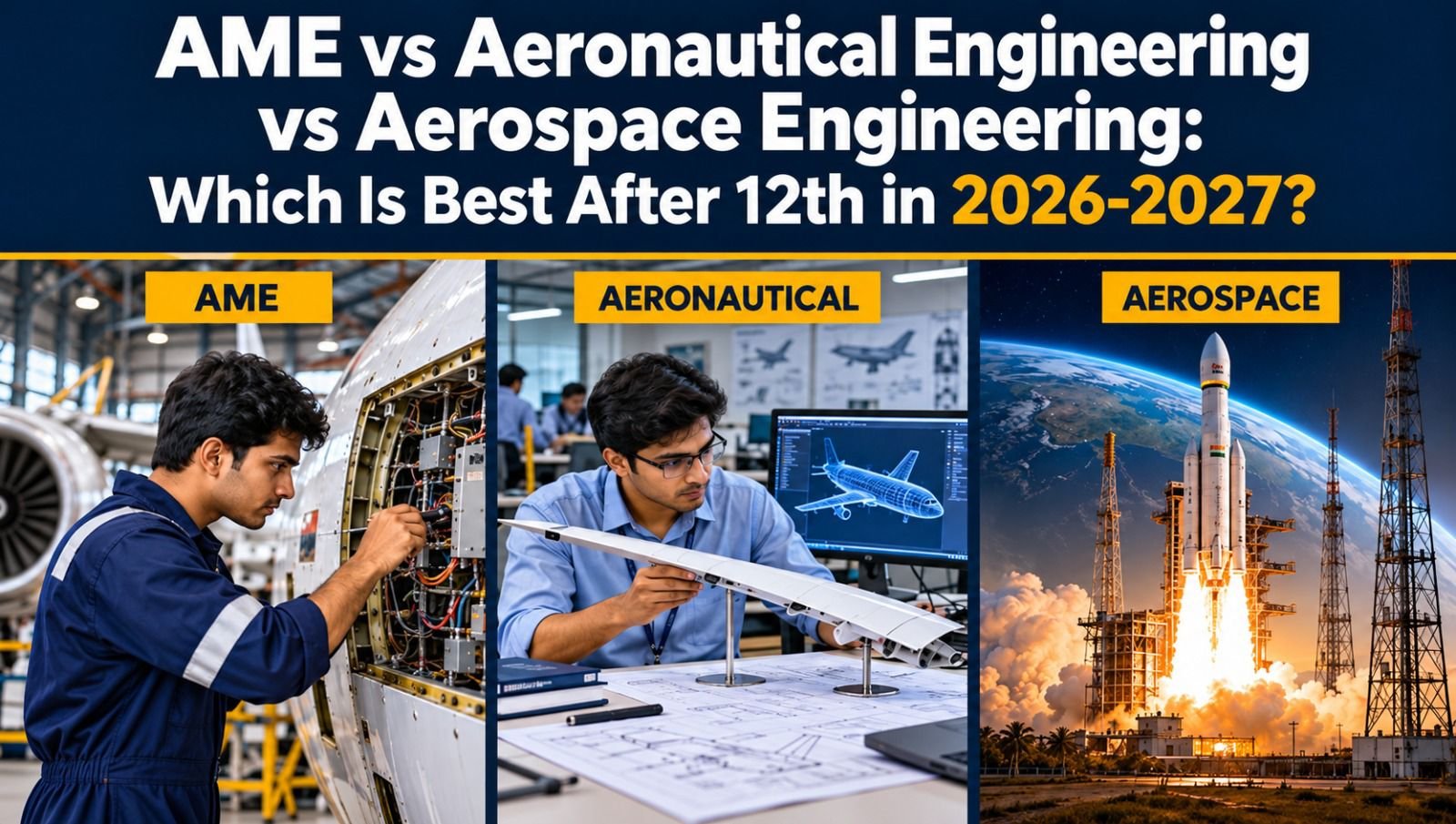
AME VS Aeronautical Engineering VS Aerospace Engineering: Which One is Best After 12th in 2026?
- AME
- November 12, 2026
Introduction
Deciding what course one should pursue after Class 12 can be difficult, especially since there are three such aviation-related courses that seem very much alike – Aircraft Maintenance Engineering (AME), Aeronautical Engineering, and Aerospace Engineering.
However, all three have one thing in common; they deal with aircraft and aviation, but they prepare you for different professions. AME is about maintaining and inspecting aircraft. Aeronautical Engineering is about designing and developing aircraft. Aerospace Engineering includes not only aircraft but also spacecraft.
Therefore, which course is the best after 12th in 2026?
The answer depends on your career goal. If you like doing maintenance on airplanes, then AME might suit you. If designing and developing airplanes is what you are interested in, then Aeronautical Engineering should be taken into account. If your area of interest is rockets, satellites, spacecraft, etc., then perhaps Aerospace Engineering is for you.
Now let's compare all three programs and make a well-informed choice regarding your future in the aviation field.
Quick Answer: Which Course to Choose After Class 12?
-
Best for aircraft maintenance and inspection : Aircraft Maintenance Engineering (AME).
-
Best for Designing and developing aircrafts. Aeronautical Engineering.
-
Best for working with aircrafts, spacecraft and space technologies: Aerospace Engineering.
The correct answer varies from person to person. It depends on whether you wish to work on maintaining aircrafts, designing them or working with a variety of aerospace technologies.
Difference between AME, Aeronautical Engineering, and Aerospace Engineering
The key difference is in what you study and the type of work that you would be doing. Aircraft Maintenance Engineering is a specialised pathway focused on keeping aircraft safe and airworthy. Aeronautical Engineering is a conventional engineering degree pathway focused on aircraft technology. Aerospace Engineering extends the engineering scope to include both atmospheric flight and space-related systems.
Here is a side-by-side comparison.
|
Comparison Factor |
AME |
Aeronautical Engineering |
Aerospace Engineering |
|
Full Form |
Aircraft Maintenance Engineering |
Aeronautical Engineering |
Aerospace Engineering |
|
Main Focus |
Aircraft maintenance, inspection, and airworthiness |
Aircraft design, development, and testing |
Aircraft, spacecraft, and flight systems |
|
Typical Study Route |
Approved maintenance training and applicable licence examinations |
B.E./B.Tech degree |
B.E./B.Tech degree |
|
Learning Approach |
Practical maintenance, technical knowledge, and regulatory procedures |
Engineering theory, design, analysis, and testing |
Engineering theory, flight science, design, and advanced systems |
|
Typical Work Environment |
Hangars, maintenance facilities, and MRO organisations |
Engineering offices, laboratories, factories, and testing facilities |
Aerospace laboratories, manufacturing facilities, and research environments |
|
Potential Career Paths |
Licensed aircraft maintenance professional and other maintenance and technical roles |
Aeronautical design, manufacturing, testing, and engineering roles |
Aerospace design, propulsion, space systems, research, and engineering roles |
|
Best Suited For |
Students who enjoy hands-on technical work |
Students interested in how aircraft are designed and built |
Students interested in aviation and space technology |
Important: AME is not automatically equivalent to a B.E. or B.Tech degree. Its training, examinations, and licensing requirements follow a different regulatory pathway. It all depends on the course that you choose.
1. Aircraft Maintenance Engineering (AME) After 12th
Aircraft Maintenance Engineering is a specialised area of aviation which would suit those individuals wishing to maintain aircraft safety.
All aircraft need periodic inspections, maintenance and fault repairs, along with adherence to airworthiness regulations. The Aircraft Maintenance Engineers operate in these processes.
Unlike an engineering program that primarily involves product/system design, an AME course involves learning about aircraft systems, finding technical faults, following proper maintenance procedures, and complying with aviation laws.
What Do You Study in AME?
Depending on the training course and specialization offered, you can learn:
-
Structures and materials used in aircraft
-
Engines and propulsion systems for aircraft
-
Electrical systems and instruments of an aircraft
-
Systems and components of aircraft
-
Technical documentation and maintenance procedures
-
Aviation safety and airworthiness standards
-
Subjects of regulations and licensing in aviation
-
The exact syllabus depends on the path and specialization chosen.
Career Prospects After AME
Career prospects after AME may be found within:
-
Maintenance and technical support for aircraft
-
Aircraft inspections and maintenance services
-
Maintenance, Repair and Overhaul (MRO) companies
-
Engineering and maintenance divisions of airlines
-
Component maintenance and repairs for aircraft
-
Certified positions in aircraft maintenance based on licence and authority specifications
The key thing for students to understand is that finishing the course does not guarantee automatic licensing as a certificated Aircraft Maintenance Engineer. This is because the ability to get this privilege depends on meeting certain requirements, such as examinations and experience, among others.
Who Should Choose AME?
You should consider AME program if:
-
You like to work with machines, engines, and systems.
-
You like to learn in practice-oriented ways rather than design-oriented ways.
-
Find yourself interested in understanding how aircraft inspection and maintenance work.
-
Can accept following rigid protocols.
-
Interested in establishing a career in airline maintenance or aircraft MRO operations.
If you enjoy the technical preparation of an aircraft to make it fit to fly and not its design, then the AME course should not be ignored.
2. Aeronautical Engineering after 12th
Aeronautical Engineering is an engineering discipline, which deals with airplanes operating in the Earth's atmosphere.
It covers aspects such as airplane design, motion of the airplanes in the atmosphere, structure and structural strength of the airplanes, and systems of the airplanes.
A standard B.E/B.Tech course includes theory classes, lab works, project works and, in some cases, special design and testing activities.
What Do You Study in Aeronautical Engineering?
Typical courses are:
-
Aerodynamics
-
Aircraft structures and materials
-
Aircraft propulsion
-
Flight mechanics
-
Aircraft design
-
Stability and control
-
Fundamentals of avionics
-
Computational methods and engineering simulation
This course enables students to comprehend the engineering concepts related to the performance, stability, structural strength, and efficiency of aircraft.
What Are The Career Opportunities for Those Who Have Learned Aeronautical Engineering?
Based on your potential, qualifications, specialization, and the requirements of employers, you can be involved in any of the following activities:
-
Aircraft design and development
-
Aerodynamics
-
Structural engineering of aircraft
-
Aerospace industry
-
Engineering simulation and testing
-
Development of aircraft systems
-
Quality, manufacturing, and technical engineering
-
Specialized engineering research
The students can seek job opportunities in the manufacturers of aircraft, aerospace industry, engineering firms, defense sectors, and research establishments.
Whom Is Aeronautical Engineering Suited For?
This class would be perfect for you if:
-
You want to study the design and development of airplanes.
-
You have an interest in physics, math, mechanics, and problem-solving.
-
Like the aspects of aircraft performance and structural engineering.
-
I enjoy engineering projects, simulations, and design work.
-
Are seeking a conventional engineering degree, specialized in aviation.
-
If you have an interest in problems, such as how an aircraft wing produces lift or fuel economy improvements, then Aeronautical Engineering is your way forward.
3. Aerospace Engineering After 12th
Aerospace Engineering has a broader scope than Aeronautical Engineering. It includes aircraft-related engineering and extends into spaceflight, spacecraft, satellites, and associated technologies.
The exact balance between aeronautics and astronautics depends on the university and its curriculum. Some programmes focus heavily on aircraft, while others provide more opportunities to study propulsion, orbital mechanics, spacecraft systems, and space-related engineering.
What Is Taught in Aerospace Engineering?
The topics could be something like the following:
-
Aerodynamics and flight mechanics
-
Aerospace structures
-
Propulsion systems
-
Fluid mechanics and thermodynamics
-
Flight dynamics and control
-
Basics of rockets and spacecrafts
-
Orbital mechanics
-
Satellite systems and space technology
-
Advanced topics depend on universities and specialisation.
What are the Career Prospects After Studying Aerospace Engineering?
Career prospects may include the following:
-
Aerospace systems design and development
-
Aircraft and spacecraft engineering
-
Propulsion engineering
-
Spacecraft systems engineering
-
Computational fluid dynamics
-
Aerospace manufacturing and testing
-
Guidance, navigation, and control
-
Advanced study and research postgraduate
They might be able to explore employment possibilities with aerospace companies, companies from the space sector, research organizations, defense organizations, or engineering firms depending on their career preference.
Studying Aerospace Engineering does not necessarily mean that one is qualified to work in all space industry jobs. Some employers might have other requirements.
Aerospace Engineer—Who Should Choose This Major?
Choose Aerospace Engineering if you:
-
Have a passion for airplanes and space science.
-
Enjoy Physics, Mathematics, mechanics, and advanced technology.
-
Want to learn about rockets, satellites, propulsion, or spacecraft.
-
Have an interest in research and simulation or complex engineering systems?
-
Consider continuing your education at the postgraduate level in a specialized field within aerospace.
You should consider aerospace engineering if your area of interest goes beyond planes to rockets, satellites, or propulsion systems.
AME v/s Aeronautical Engineering v/s Aerospace Engineering: Eligibility after 12th
While students tend to compare the subjects taught and the careers they could pursue after studying a certain course, they often forget to check the eligibility criteria for the course.
Eligibility for AME
For candidates following the Indian Aircraft Maintenance Engineer licensing pathway, the Directorate General of Civil Aviation (DGCA) specifies relevant educational requirements, including Class 12 Physics, Chemistry, and Mathematics or an accepted equivalent.
The approved training route, admission conditions, and requirements for obtaining a licence must be checked separately. Not every course advertised as AME training necessarily leads to the same regulatory outcome.
Eligibility for Aeronautical Engineering
For a B.E. or B.Tech in Aeronautical Engineering, students generally need to meet the institution's Class 12 science and Mathematics requirements. Not only Physics but also Mathematics is important along with any other subjects that might be required by the university.
Admission may depend on JEE Main, the state exam, or a university test, among others, depending on the institution.
Eligibility for Aerospace Engineering
Eligibility for B.E. and B.Tech courses in Aerospace Engineering normally consists of a qualifying Class 12 education including Physics and Mathematics, plus the specified subjects and minimum marks set by the institution.
The requirements and minimum marks may vary in case of an entrance test. It is important to consult the admission notification rather than a generic eligibility criterion.
Before applying: Determining whether the course is recognized/approved, which qualification it offers, its eligibility criteria, and process of admission for the academic year 2026-27.
Course Duration How Long is Each Course
Course duration depends on the qualification and training pathway.
|
Course |
Typical duration |
|
AME |
Varies by approved training route; some pathways involve approximately four years of training followed by practical experience and licensing requirements |
|
B.E./B.Tech Aeronautical Engineering |
Generally four years |
|
B.E./B.Tech Aerospace Engineering |
Generally four years |
These are general planning estimates, not guarantees for every institution. The time required to complete an AME licence pathway can extend beyond the classroom training period because practical experience, examinations, and other applicable
AME VS Aeronautical Engineering VS Aerospace Engineering: Scope of Job
All three options have their own approaches that enable you to take part in the field of aviation and aerospace engineering. It depends on your qualification, technical skills, experience, and the demands of the job.
Scope of Job after AME
Jobs related to AME involve aircraft maintenance, technical inspection, troubleshooting and maintenance. The opportunities can be found with airlines, MRO companies, component repair firms, and other aviation maintenance firms.
For the jobs where you need an aircraft maintenance license or certificate authority, you have to meet the requirements of the license or certificate.
Scope of Career After Aeronautical Engineering
Some of the careers that could be pursued after taking Aeronautical Engineering include aircraft design, structural analysis, aerodynamic analysis, manufacture, simulation, and testing.
Those students who learn engineering basics and become skilled through project work and internship might be better equipped to pursue specialized jobs.
Career Scope After Aerospace Engineering
Aerospace Engineering can lead towards aircraft and spacecraft systems, propulsion, satellite technology, aerospace manufacturing, simulation, and research.
The range of opportunities depends on the degree curriculum, specialisation, technical portfolio, and qualifications required by individual employers.
Which Course has Better Job Prospects?
There is no absolute answer to this question. AME will help students become specialized in maintenance-related jobs whereas Aeronautical and Aerospace Engineering will help students become engineers.
Job prospects differ according to location, employer, economic scenario, and candidate qualifications. Therefore, do not select the course on the basis of general assumptions but compare the performance and other related facts.
Salary after AME, Aeronautical Engineering, and Aerospace Engineering
The salary is an important criterion while choosing the course after Class 12. However, it is better to compare realistic job pathways than rely on a single salary figure for an entire field.
Earnings can vary considerably according to the employer, location, experience, specialisation, and, in AME-related positions, the licence and authorisations held.
|
Career path |
What can influence earnings? |
|
AME and aircraft maintenance |
Licensing status, practical experience, aircraft or component specialisation, employer, and shift responsibilities |
|
Aeronautical Engineering |
Design skills, engineering tools, project experience, specialisation, and employer |
|
Aerospace Engineering |
Technical specialisation, simulation or research skills, project experience, higher qualifications, and employer |
Students should ask colleges for recent placement data that clearly distinguishes the number of students placed, job roles, median salary, highest salary, and the proportion of the graduating batch covered by the report.
Which course has the highest salary?
None guarantees the highest salary. Having the right technical knowledge, skills, and qualification is more important than possessing an AME/B.Tech degree in Aeronautical Engineering.
Which Is Better: AME or B.Tech in Aeronautical Engineering?
This is one of the most important comparisons for students interested in aircraft.
The key difference is the type of qualification and career preparation.
Choose AME if your goal is to pursue aircraft maintenance and, subject to the required licensing pathway, work towards the privileges associated with aircraft maintenance certification.
Select B.Tech in Aeronautical Engineering for a career in designing, analyzing, manufacturing, and developing aircrafts.
Note that both these options cannot be interchanged. An engineering program doesn’t automatically guarantee an AME license, and similarly, AME training doesn’t automatically give a B.Tech degree.
You may want to consider another simple question, if in doubt: Do you prefer investigating and maintaining the system of the aircraft or do you prefer working on the engineering aspects involved in the design of the aircraft?
Aeronautical Engineering vs. Aerospace Engineering: Which is Better?
The difference is mainly the breadth of the subject.
Aeronautical Engineering focuses on aircraft and flight within the atmosphere. Aerospace Engineering covers that area and can also include spacecraft, satellites, rocket propulsion, and spaceflight systems.
Neither is automatically better than the other. It all depends upon the subject matter and what your area of interest is.
For example, if your intention is to become an expert in aircraft design and efficiency, then Aeronautical Engineering can be a perfect fit for you. However, if you wish to have more options in terms of either aircraft or space systems, then Aerospace Engineering would be a better start for you.
Just go through the course material that will be covered each semester. The course title alone does not tell you how much attention a programme gives to aircraft design, propulsion, spacecraft, or research.
How to Select the Right Aviation Course after 12th in 2026
Think of these five things before you make a final decision.
1. Figure out the job you want
Do you want to maintain aircraft, design them, or work on aircraft and spacecraft systems? Start with the type of work that interests you rather than the popularity of a course.
2. Determine your academic strengths
The three areas have technical subjects to learn; however, their focus is different. AME places great importance on the process of maintenance and knowledge of systems. AE & AS have a lot of engineering and mathematics theory.
3. Know the qualifications
Check whether you will receive a degree, complete an approved training programme, or follow a licensing pathway. Do not assume that similarly named courses provide identical qualifications.
4. Understand the institution
In the case of AME, make sure that the DGCA accreditation and training route are appropriate. In case of engineering degrees, make sure that the university is an accredited one and the program has the required accreditation. Other issues that need to be considered are laboratory facilities, workshops, teaching faculty, internships, and placements.
5. Consider the total cost and repercussions.
Include tuition costs, living expenses, examination fees, fieldwork, licensing costs if any, and the time it will take before you become eligible for your position.
A bit of research can save you from basing your choice solely on the appeal of the brochure.
Final Verdict: Which Course To Choose After Class 12 in 2026?
It all depends on the nature of the career that you would like to pursue.
If you want to be into aircraft maintenance and technical inspections, you should choose AME.
If designing and developing aircraft interests you more, then Aeronautical Engineering is the right course for you.
However, if you would like to study aircraft as well as other space objects, Aerospace Engineering is your destination.
But if you are interested in aviation and are in doubt about which direction to choose, consider taking time to make comparisons of the actual curriculum, qualifications, training facilities, and career requirements for each program.
For students who are considering AME, the next thing to do is to understand the actual training programs available, admission requirements, and licensing process. Making the right decision is better than choosing a program that only has an impressive sounding name and guaranteed salary.
Frequently Asked Questions (FAQ)
Which is better to pursue after 12th AME or Aeronautical Engineering or Aerospace Engineering?
AME is suited to students interested in aircraft maintenance and airworthiness. Aeronautical Engineering is suited to students interested in aircraft design and development. Aerospace Engineering is suited to students interested in aircraft as well as spacecraft and space technology. The best option depends on your career goal.
2. Is AME better than Aeronautical Engineering?
The answer is no for both since neither of them can be termed superior in all cases. AME follows the aircraft maintenance and licensing program, while Aeronautical Engineering is normally pursued as a regular engineering program.
3. Which is Harder between Aerospace Engineering and Aeronautical Engineering?
Both of them need excellent technical skills along with a good knowledge base in mathematics and physics. However, there could be some added topics related to space in case of aerospace engineering programmes.
4. Can I pursue a career as an Aircraft Maintenance Engineer after B.Tech Aeronautical Engineering?
A simple B.Tech degree is not enough to get an AME license, nor its rights of certification. The candidates will have to meet the licensing criteria of DGCA for that particular route.
5. Is it possible to study Aerospace Engineering after Class 12?
Yes, students who have satisfied the required criteria for Class 12 can enroll themselves for B.E. /B.Tech. programs in Aerospace Engineering.
6. Is AME a degree course?
The term AME is commonly used for Aircraft Maintenance Engineering training, which follows a regulatory pathway different from a conventional B.E. or B.Tech degree. The qualification awarded depends on the specific programme. Always verify what the institution offers.
7. Which are some of the main subjects in AME, Aeronautical Engineering, and Aerospace Engineering?
Physics and Mathematics form part of the core subjects. In addition, chemistry is also relevant in the normal Class 12 criteria. Nevertheless, the required subjects vary depending on the programme of interest.
8.Which course is best suited to prepare someone for a career in the space sector?
The best course is Aerospace Engineering since it entails the study of issues like spacecraft, propulsion, satellite, and space systems.
9. Will I have the opportunity to work outside my country after taking these courses?
Yes, it is likely possible, although it will all depend on the company, location, licensing, qualifications, among other factors. This is due to the fact that aircraft maintenance licensing differs in each country.
10. How am I going to be sure about everything before making an application for admission in 2026?
Inquire about the recognition of the college, admission requirements, duration of study, qualifications offered, tuition costs, training programs, employment opportunities, and any other examinations.
Recent Posts





















































Share This News